
Read the original · Check the transcription
Gibbs Family Papers, Reel 2, frame 3880
Preserved transcription
Transcription matched to this Wisconsin microfilm frame. Preserved from the supplied frame transcription; compare uncertain readings with the scan.
229
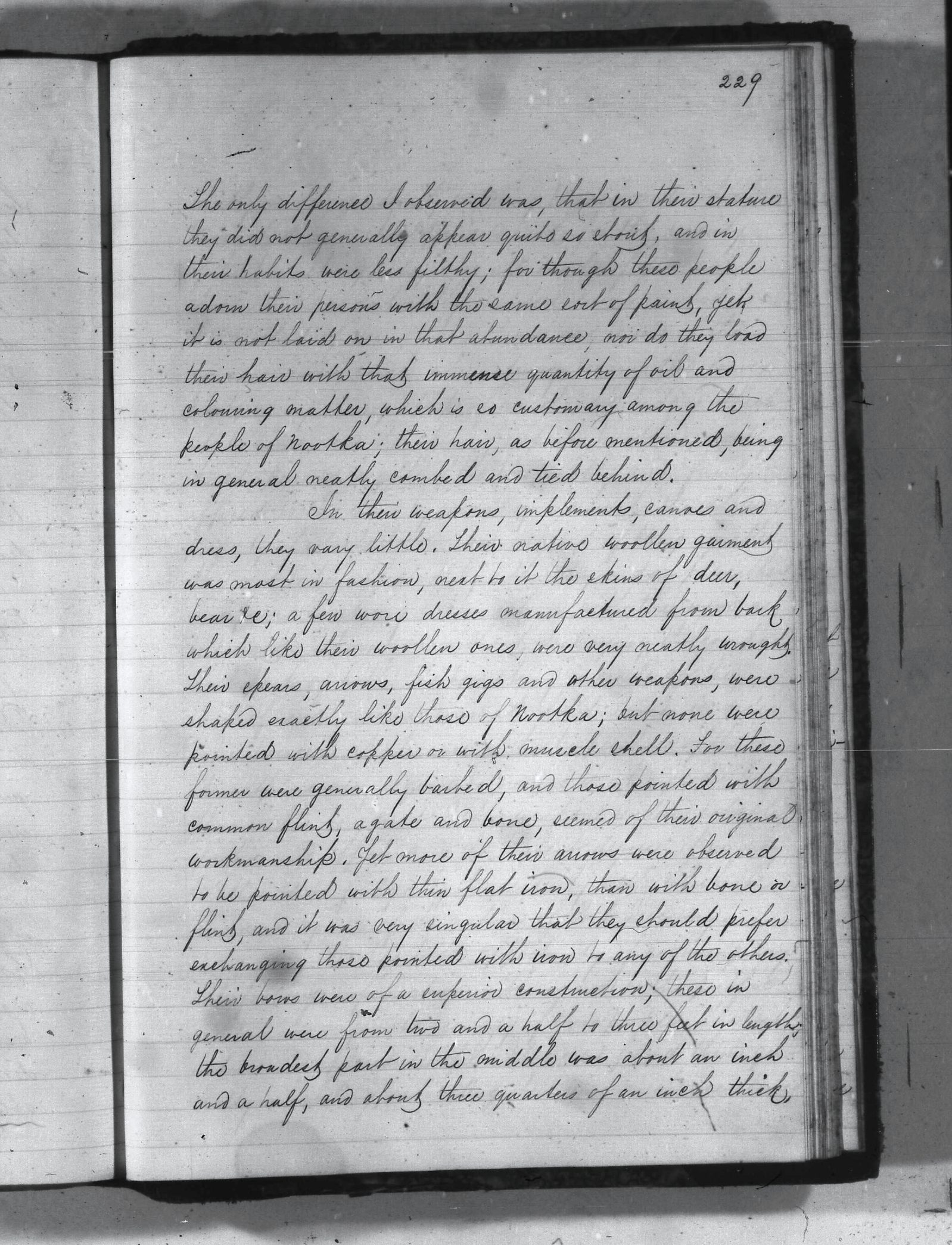
The only difference I observed was, that in their stature
they did not generally appear quite so stout, and in
their habits were less filthy; for though these people
adorn their persons with the same sort of paint, yet
it is not laid on in that abundance, nor do they load
their hair with that immense quantity of oil and
colouring matter, which is so customary among the
people of Nootka; their hair, as before mentioned, being
in general neatly combed and tied behind.
In their weapons, implements, canoes and
dress, they vary little. Their native woollen garment
was most in fashion, next to it the skins of deer,
bear &c; a few wore dresses manufactured from bark
which like their woollen ones, were very neatly wrought.
Their spears, arrows, fish gigs and other weapons, were
shaped exactly like those of Nootka; but none were
pointed with copper or with muscle shell. For[?] these[?]
former were generally barbed, and those pointed with
common flint, agate and bone, seemed of their original
workmanship. Yet more of their arrows were observed
to be pointed with thin flat iron, than with bone or
flint, and it was very singular that they should prefer
exchanging those pointed with iron to any of the others.
Their bows were of a superior construction; these in
general were from two and a half to three feet in length,
the broadest part in the middle was about an inch
and a half, and about three quarters of an inch thick,
Wisconsin Historical Society · WHS-R2-3880 · George Gibbs IV (manuscript volume, ms p. 229), 1856 (Olympia) and later additions
Open the complete archive frame record →