
Read the original · Check the transcription
Gibbs Family Papers, Reel 2, frame 3830
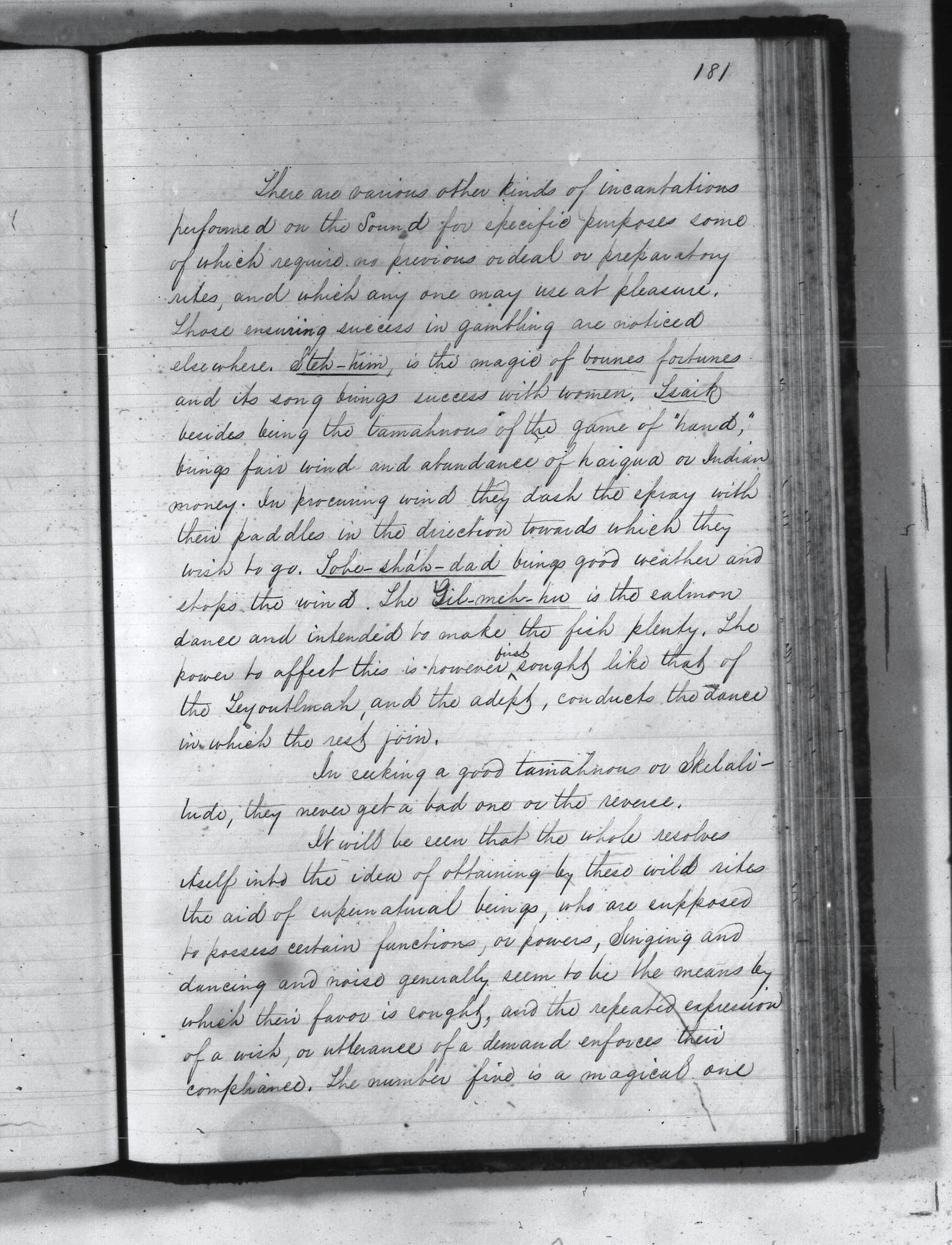
Preserved transcription
Transcription matched to this Wisconsin microfilm frame. Preserved from the supplied frame transcription; compare uncertain readings with the scan.
[page number: 181]
There are various other kinds of incantations
performed on the Sound for specific purposes some
of which require no previous ordeal or preparatory
rites, and which any one may use at pleasure.
Those ensuring success in gambling are noticed
elsewhere. Steh-him[?], is the magic of bonnes fortunes
and its song brings success with women. Tsaik[?]
besides being the tamahnous of the game of "hand,"
brings fair wind and abundance of haiqua or Indian
money. In procuring wind they dash the spray with
their paddles in the direction towards which they
wish to go. Soho-sháh-dad[?] brings good weather and
stops the wind. The Gib-meh-hu[?] is the salmon
dance and intended to make the fish plenty. The
power to affect this is however [inserted: first] sought like that of
the Leyoutlmah[?], and the adept, conducts the dance
in which the rest join.
In seeking a good tamahnous or Skelali-
tud[?], they never get a bad one or the reverse.
It will be seen that the whole resolves
itself into the idea of obtaining by these wild rites
the aid of supernatural beings, who are supposed
to possess certain functions, or powers, Singing and
dancing and noise generally seem to be the means by
which their favor is sought, and the repeated expression
of a wish, or utterance of a demand enforces their
compliance. The number five is a magical one
Wisconsin Historical Society · WHS-R2-3830 · George Gibbs IV (manuscript volume, ms p. 181), 1856 (Olympia) and later additions
Open the complete archive frame record →