
Read the original · Check the transcription
Gibbs Family Papers, Reel 2, frame 3798
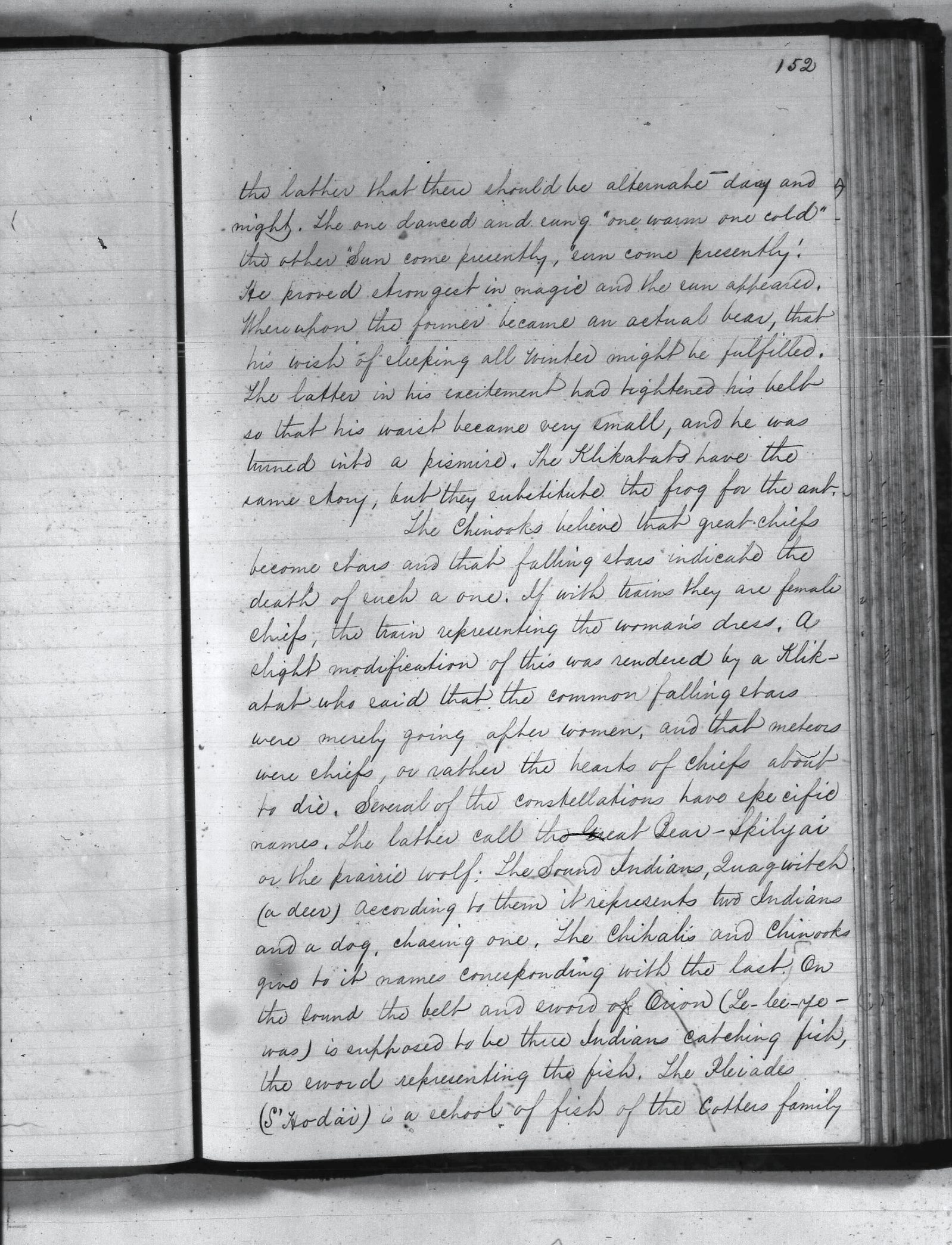
Preserved transcription
Transcription matched to this Wisconsin microfilm frame. Preserved from the supplied frame transcription; compare uncertain readings with the scan.
152
the latter that there should be alternate day and
night. The one danced and sung "one warm one cold" –
the other "Sun come presently, sun come presently."
He proved strongest in magic and the sun appeared.
Whereupon the former became an actual bear, that
his wish of sleeping all winter might be fulfilled.
The latter in his excitement had tightened his belt
so that his waist became very small, and he was
turned into a pismire. The Klikatats have the
same story, but they substitute the frog for the ant.
The Chinooks believe that great chiefs
become stars and that falling stars indicate the
death of such a one. If with trains they are female
chiefs, the train representing the woman's dress. A
slight modification of this was rendered by a Klik-
atat who said that the common falling stars
were merely going after women, and that meteors
were chiefs, or rather the hearts of chiefs about
to die. Several of the constellations have specific
names. The latter call the Great[?] Bear – Spilyai[?]
or the prairie wolf. The Sound Indians, Quaqwitch[?]
(a deer) according to them it represents two Indians
and a dog, chasing one. The Chihalis and Chinooks
give to it names corresponding with the last. On
the Sound the belt and sword of Orion (Le-lee-fo[?]-
was) is supposed to be three Indians catching fish,
the sword representing the fish. The Pleiades
(S'Hodai[?]) is a school of fish of the Cotters[?] family
Wisconsin Historical Society · WHS-R2-3798 · George Gibbs IV (manuscript volume, ms p. 152), 1856 (Olympia) and later additions
Open the complete archive frame record →