
Read the original · Check the transcription
Gibbs Family Papers, Reel 2, frame 3793
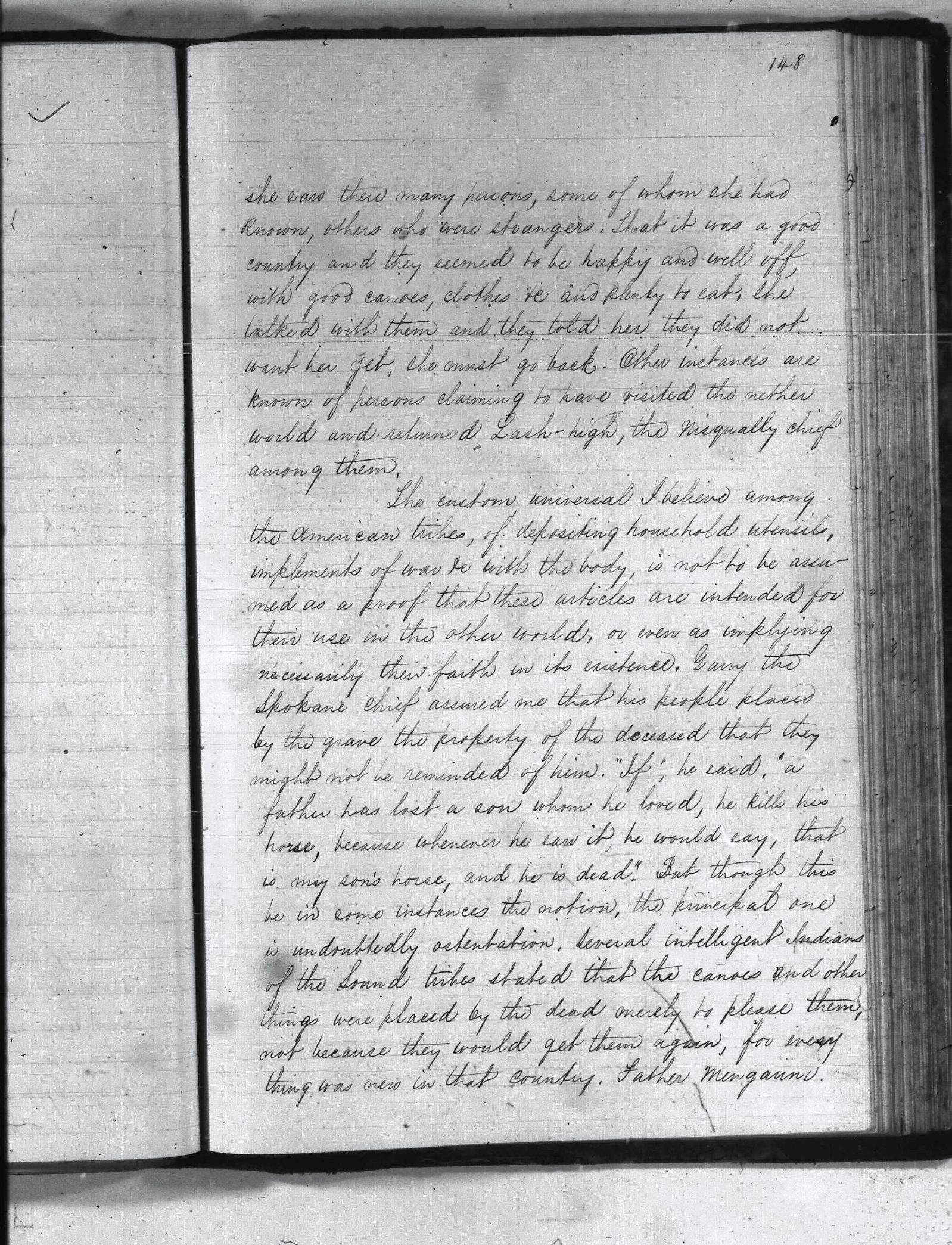
Preserved transcription
Transcription matched to this Wisconsin microfilm frame. Preserved from the supplied frame transcription; compare uncertain readings with the scan.
[left page: blank except a pencil tick mark ✓ near top]
148
she saw there many persons, some of whom she had
known, others who were strangers. That it was a good
country and they seemed to be happy and well off,
with good canoes, clothes &c and plenty to eat. She
talked with them and they told her they did not
want her yet, she must go back. Other instances are
known of persons claiming to have visited the nether
world and returned, Lash-high[?], the Nisqually chief
among them.
The custom universal I believe among
the american tribes, of depositing household utensils,
implements of war &c with the body, is not to be assu-
med as a proof that these articles are intended for
their use in the other world, or even as implying
necessarily their faith in its existence. Garry[?] the
Spokane chief assured me that his people placed
by the grave the property of the deceased that they
might not be reminded of him. "If", he said, "a
father has lost a son whom he loved, he kills his
horse, because whenever he saw it, he would say, that
is my son's horse, and he is dead". But though this
be in some instances the notion, the principal one
is undoubtedly ostentation. Several intelligent Indians
of the Sound tribes stated that the canoes and other
things were placed by the dead merely to please them,
not because they would get them again, for every
thing was new in that country. Father Mengarini[?]
Wisconsin Historical Society · WHS-R2-3793 · George Gibbs IV (manuscript volume, ms p. 148), 1856 (Olympia) and later additions
Open the complete archive frame record →