
Read the original · Check the transcription
Gibbs Family Papers, Reel 2, frame 3783
Preserved transcription
Transcription matched to this Wisconsin microfilm frame. Preserved from the supplied frame transcription; compare uncertain readings with the scan.
[page number, upper right:] 139
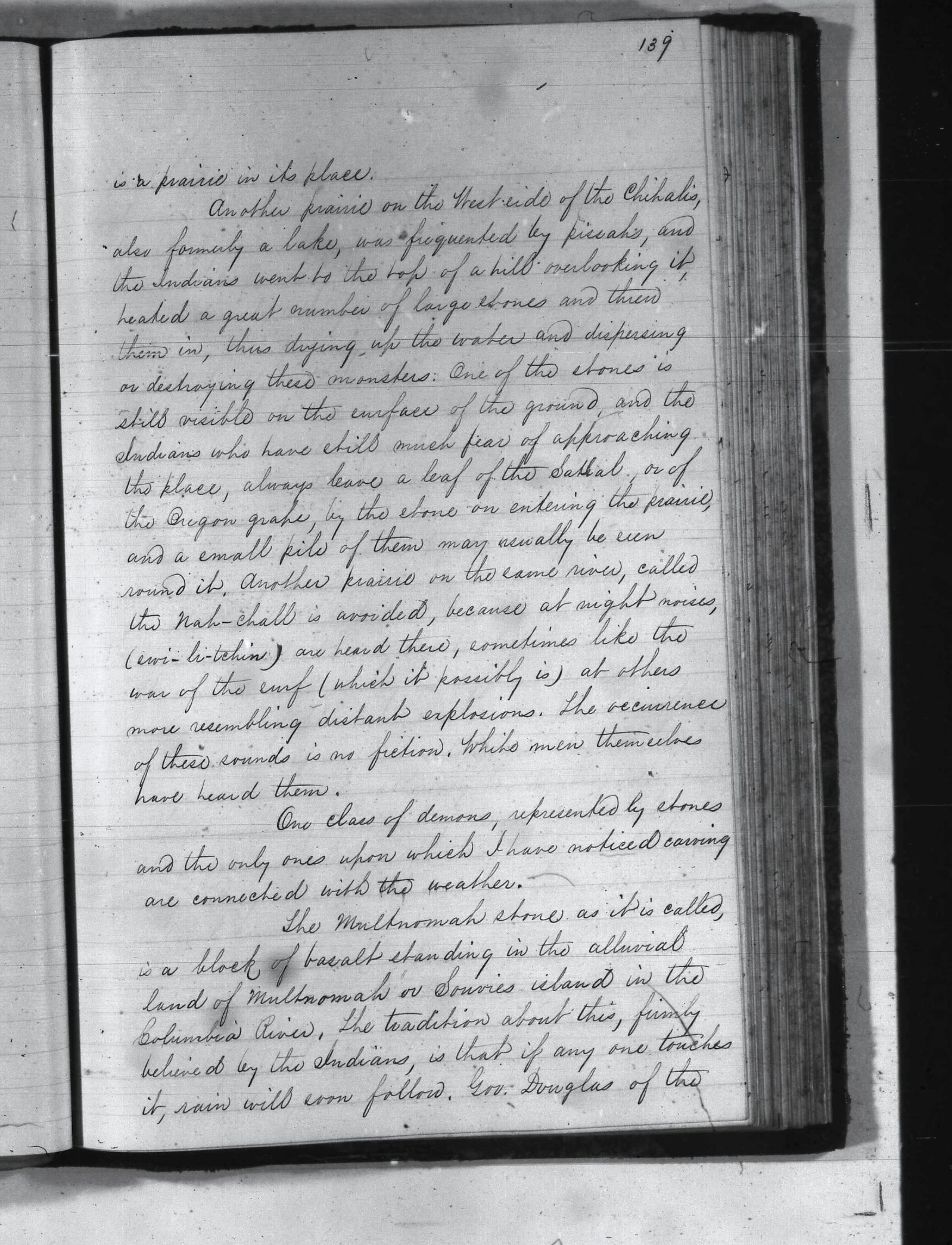
is a prairie in its place.
Another prairie on the West side of the Chihalis,
also formerly a lake, was frequented by pissahs[?], and
the Indians went to the top of a hill overlooking it,
heated a great number of large stones and threw
them in, thus drying up the water and dispersing
or destroying these monsters. One of the stones is
still visible on the surface of the ground, and the
Indians who have still much fear of approaching
the place, always leave a leaf of the Sallal[?], or of
the Oregon grape, by the stone on entering the prairie,
and a small pile of them may usually be seen
round it. Another prairie on the same river, called
the Nah-chall[?] is avoided, because at night noises,
(swi-li-tchin[?]) are heard there, sometimes like the
war[?] of the surf (which it possibly is) at others
more resembling distant explosions. The occurrence
of these sounds is no fiction. White men themselves
have heard them.
One class of demons, represented by stones
and the only ones upon which I have noticed carving
are connected with the weather.
The Multnomah stone as it is called,
is a block of basalt standing in the alluvial
land of Multnomah or Souvies[?] island in the
Columbia River. The tradition about this, firmly
believed by the Indians, is that if any one touches
it, rain will soon follow. Gov. Douglas of the
Wisconsin Historical Society · WHS-R2-3783 · George Gibbs IV (manuscript volume, ms p. 139), 1856 (Olympia) and later additions
Open the complete archive frame record →