
Read the original · Check the transcription
Gibbs Family Papers, Reel 2, frame 3779
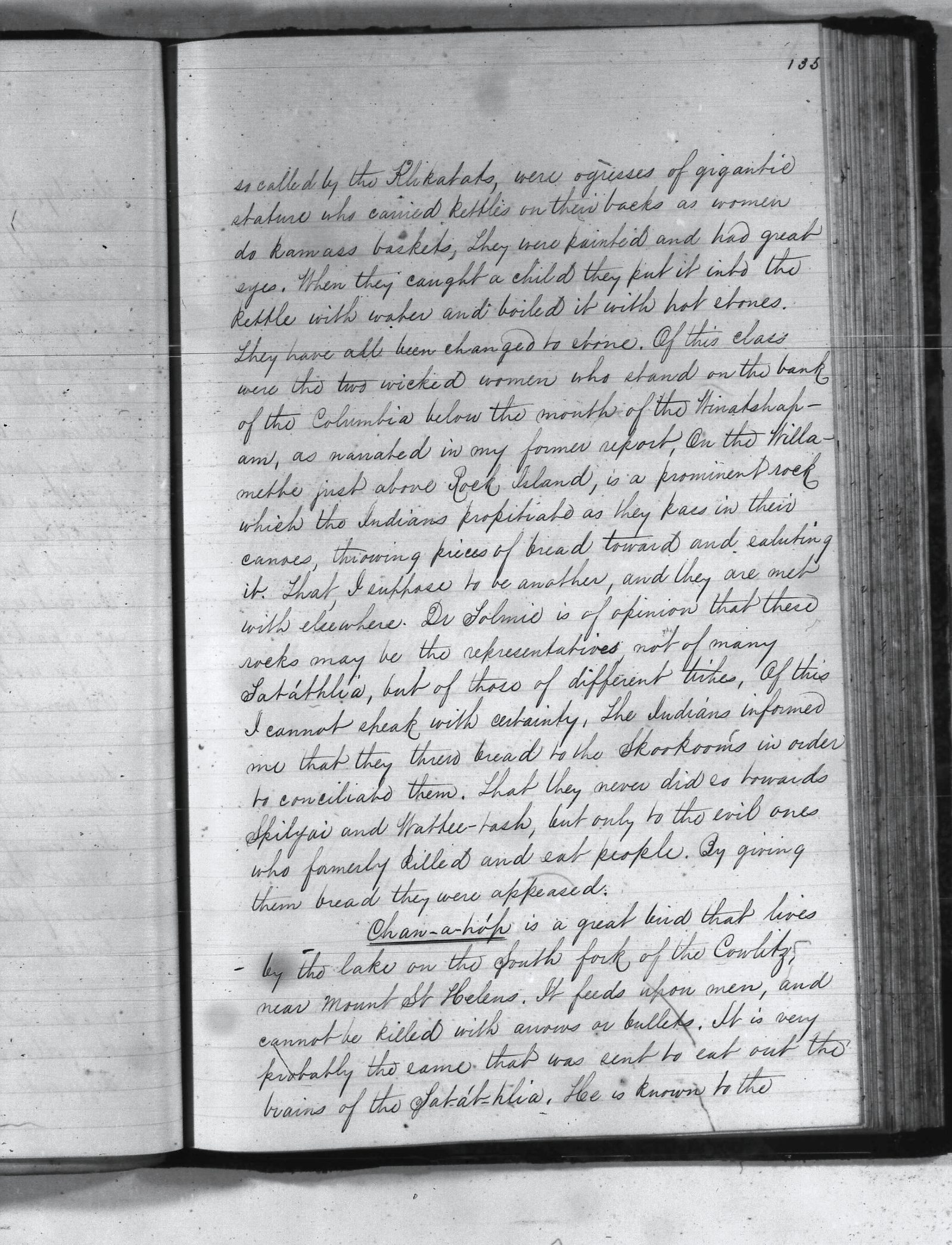
Preserved transcription
Transcription matched to this Wisconsin microfilm frame. Preserved from the supplied frame transcription; compare uncertain readings with the scan.
[page number, top right: 135]
so called by the Klikatats, were ogresses of gigantic
stature who carried kettles on their backs as women
do kamass baskets, They were painted and had great
eyes. When they caught a child they put it into the
kettle with water and boiled it with hot stones.
They have all been changed to stone. Of this class
were the two wicked women who stand on the bank
of the Columbia below the mouth of the Winatshap-
am, as narrated in my former report, On the Willa-
mette just above Rock Island, is a prominent rock
which the Indians propitiate as they pass in their
canoes, throwing pieces of bread toward and saluting
it. That, I suppose to be another, and they are met
with elsewhere. Dr Tolmie[?] is of opinion that these
rocks may be the representatives not of many
Satáthlia, but of those of different tribes. Of this
I cannot speak with certainty. The Indians informed
me that they threw bread to the Skookooms in order
to conciliate them. That they never did so towards
Spilyai and Wathee-tash[?], but only to the evil ones
who formerly[?] killed and eat people. By giving
them bread they were appeased.
Chaw-a-hóp [underlined] is a great bird that lives
- by the lake on the South fork of the Cowlitz,
near Mount St Helens. It feeds upon men, and
cannot be killed with arrows or bullets. It is very
probably the same that was sent to eat out the
brains of the Sat-át-hlia. He is known to the
Wisconsin Historical Society · WHS-R2-3779 · George Gibbs IV (manuscript volume, ms p. 135), 1856 (Olympia) and later additions
Open the complete archive frame record →