
Read the original · Check the transcription
Gibbs Family Papers, Reel 3, frame 632 (reading copy)
Preserved transcription
Transcription matched to this Wisconsin microfilm frame. Preserved from the supplied frame transcription; compare uncertain readings with the scan.
86.
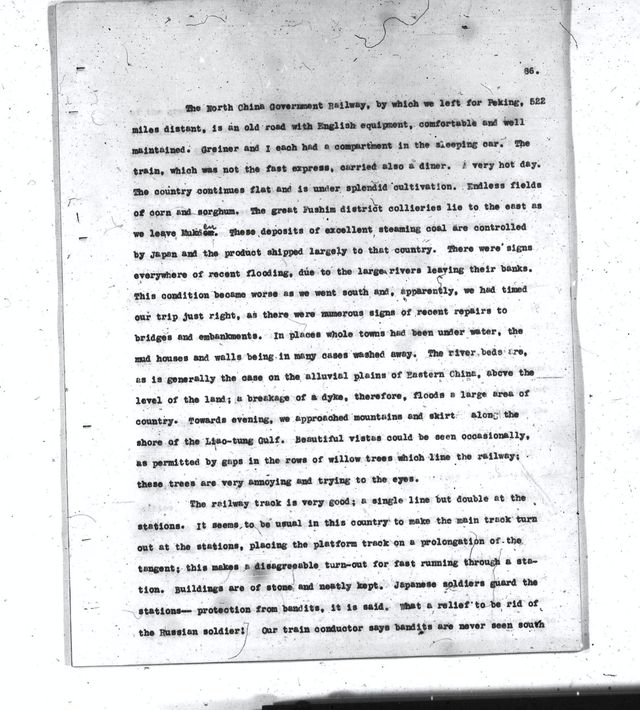
The North China Government Railway, by which we left for Peking, 522
miles distant, is an old road with English equipment, comfortable and well
maintained. Greiner and I each had a compartment in the sleeping car. The
train, which was not the fast express, carried also a diner. A[?] very hot day.
The country continues flat and is under splendid cultivation. Endless fields
of corn and sorghum. The great Fushim district collieries lie to the east as
we leave Mukdem[?] [inserted: en]. These deposits of excellent steaming coal are controlled
by Japan and the product shipped largely to that country. There were signs
everywhere of recent flooding, due to the large rivers leaving their banks.
This condition became worse as we went south and, apparently, we had timed
our trip just right, as there were numerous signs of recent repairs to
bridges and embankments. In places whole towns had been under water, the
mud houses and walls being in many cases washed away. The river beds are,
as is generally the case on the alluvial plains of Eastern China, above the
level of the land; a breakage of a dyke, therefore, floods a large area of
country. Towards evening, we approached mountains and skirt[?] along the
shore of the Liao-tung Gulf. Beautiful vistas could be seen occasionally,
as permitted by gaps in the rows of willow trees which line the railway;
these trees are very annoying and trying to the eyes.
The railway track is very good; a single line but double at the
stations. It seems to be usual in this country to make the main track turn
out at the stations, placing the platform track on a prolongation of the
tangent; this makes a disagreeable turn-out for fast running through a sta-
tion. Buildings are of stone and neatly kept. Japanese soldiers guard the
stations-- protection from bandits, it is said. What a relief to be rid of
the Russian soldier! Our train conductor says bandits are never seen south
Wisconsin Historical Society · WHS-R3-632 · Letter from George Gibbs V to journal typescript, (cont.)
Open the complete archive frame record →