
Read the original · Check the transcription
Gibbs Family Papers, Reel 3, frame 629 (reading copy)
Preserved transcription
Transcription matched to this Wisconsin microfilm frame. Preserved from the supplied frame transcription; compare uncertain readings with the scan.
[page number, top right:] 83.
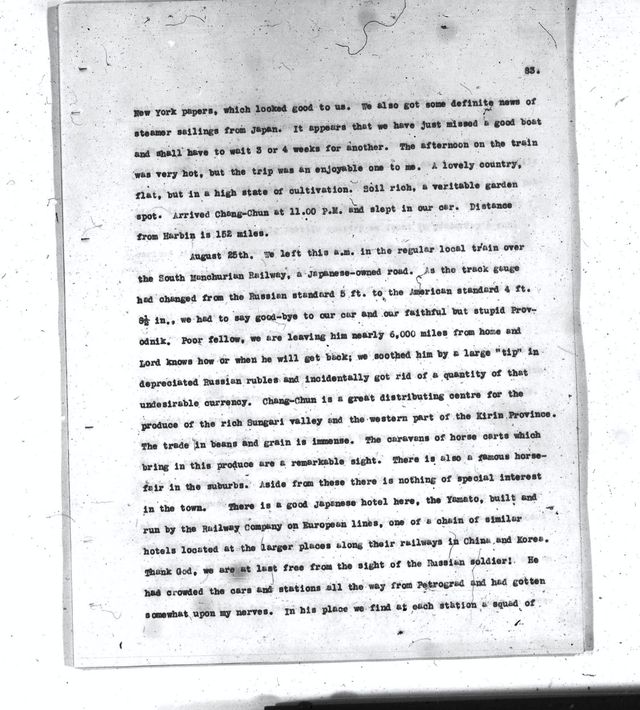
New York papers, which looked good to us. We also got some definite news of
steamer sailings from Japan. It appears that we have just missed a good boat
and shall have to wait 3 or 4 weeks for another. The afternoon on the train
was very hot, but the trip was an enjoyable one to me. A lovely country,
flat, but in a high state of cultivation. Soil rich, a veritable garden
spot. Arrived Chang-Chun at 11.00 P.M. and slept in our car. Distance
from Harbin is 152 miles.
August 25th. We left this a.m. in the regular local train over
the South Manchurian Railway, a Japanese-owned road. As the track gauge
had changed from the Russian standard 5 ft. to the American standard 4 ft.
8½ in., we had to say good-bye to our car and our faithful but stupid Prov-
odnik. Poor fellow, we are leaving him nearly 6,000 miles from home and
Lord knows how or when he will get back; we soothed him by a large "tip" in
depreciated Russian rubles and incidentally got rid of a quantity of that
undesirable currency. Chang-Chun is a great distributing centre for the
produce of the rich Sungari valley and the western part of the Kirin Province.
The trade in beans and grain is immense. The caravans of horse carts which
bring in this produce are a remarkable sight. There is also a famous horse-
fair in the suburbs. Aside from these there is nothing of special interest
in the town. There is a good Japanese hotel here, the Yamato, built and
run by the Railway Company on European lines, one of a chain of similar
hotels located at the larger places along their railways in China and Korea.
Thank God, we are at last free from the sight of the Russian soldier! He
had crowded the cars and stations all the way from Petrograd and had gotten
somewhat upon my nerves. In his place we find at each station a squad of
Wisconsin Historical Society · WHS-R3-629 · DUPLICATE microfilm exposure of frame 616 (document), (cont.)
Open the complete archive frame record →