
Read the original · Check the transcription
Gibbs Family Papers, Reel 2, frame 1727
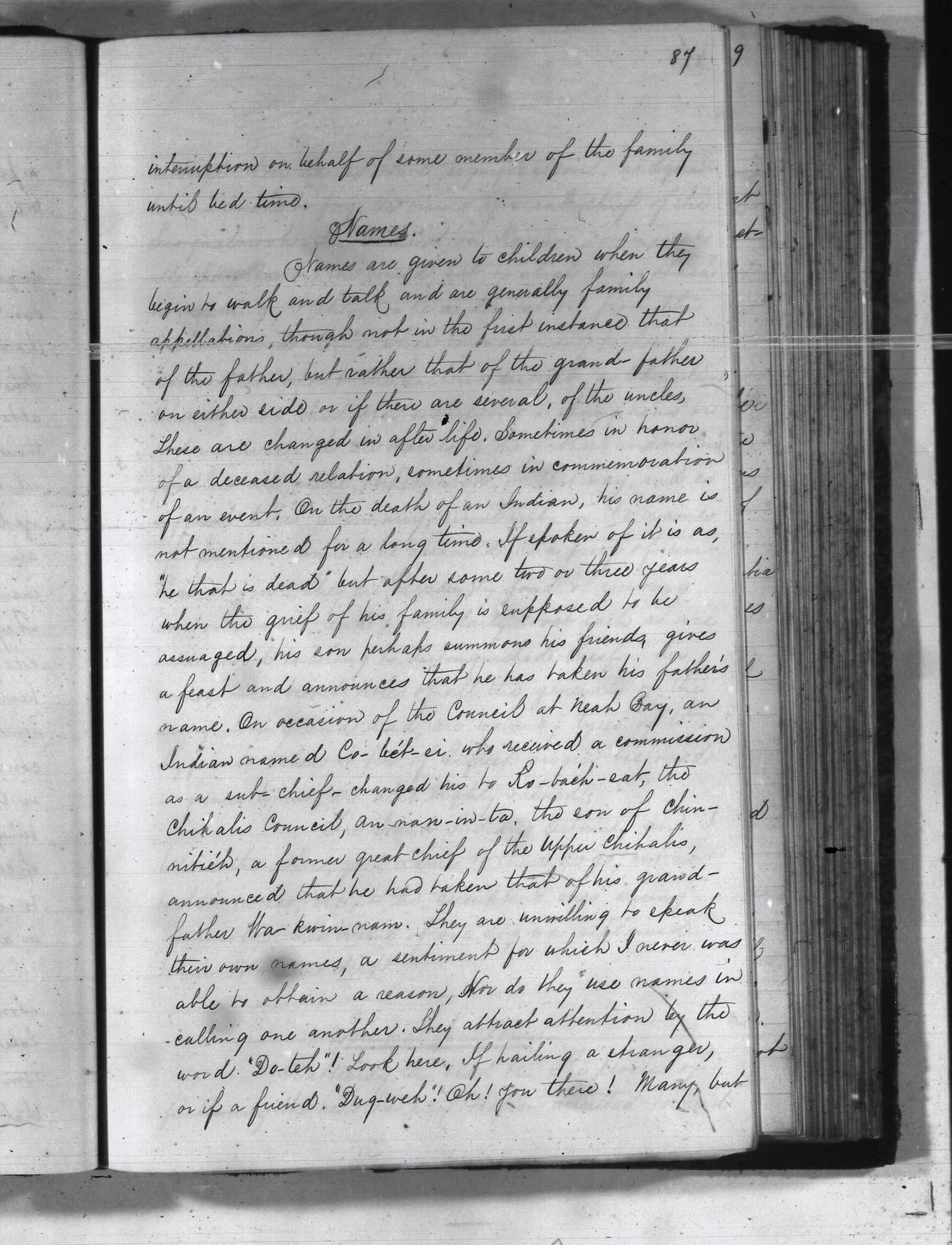
Preserved transcription
Transcription matched to this Wisconsin microfilm frame. Preserved from the supplied frame transcription; compare uncertain readings with the scan.
[page number, top right: 87 9]
interruption on behalf of some member of the family
until bed time.
Names.
Names are given to children when they
begin to walk and talk and are generally family
appellations, though not in the first instance that
of the father, but rather that of the grand-father
on either side or if there are several, of the uncles.
These are changed in after life. Sometimes in honor
of a deceased relation, sometimes in commemoration
of an event. On the death of an Indian, his name is
not mentioned for a long time. If spoken of it is as,
"he that is dead" but after some two or three years
when the grief of his family is supposed to be
assuaged, his son perhaps summons his friends, gives
a feast and announces that he has taken his father's
name. On occasion of the Council at Neah Bay, an
Indian named Co-bét-ei[?]. who received a commission
as a sub-chief- changed his to Ko-bách-eat[?]; the
Chihalis Council, an-naw-in-ta[?]. the son of Chin-
nitiéh[?], a former great chief of the Upper Chihalis,
announced that he had taken that of his grand-
father Wa-kwin-nam[?]. They are unwilling to speak
their own names, a sentiment for which I never was
able to obtain a reason, Nor do they use names in
calling one another. They attract attention by the
word 'Do-teh"! Look here, If hailing a stranger,
or if a friend. "Dug-weh"! Oh! you there! Many, but
Wisconsin Historical Society · WHS-R2-1727 · George Gibbs ms. draft on Washington Territory Indians (notebook p.61) (document), n.d. (c.1854-57?)
Open the complete archive frame record →