
Read the original · Check the transcription
Gibbs Family Papers, Reel 2, frame 1715
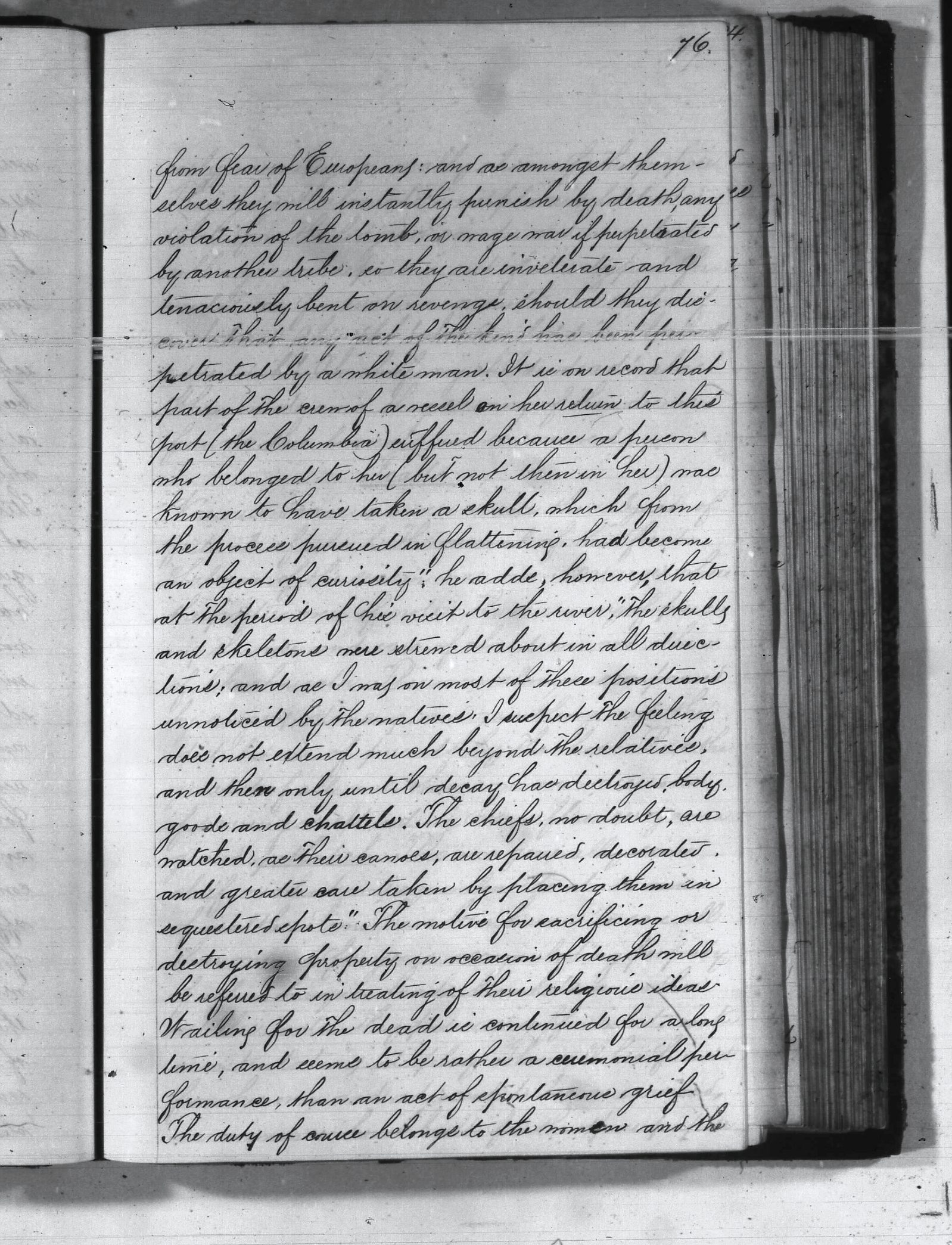
Preserved transcription
Transcription matched to this Wisconsin microfilm frame. Preserved from the supplied frame transcription; compare uncertain readings with the scan.
[page number, top right:] 76.
from fear of Europeans: and as amongst them-
selves they will instantly punish by death, any
violation of the tomb, or wage war if perpetrated
by another tribe, so they are inveterate and
tenaciously bent on revenge, should they dis-
cover that any act of the kind has been per-
petrated by a white man. It is on record that
part of the crew of a vessel on her return to this
port (the Columbia) suffered because a person
who belonged to her (but not then in her) was
known to have taken a skull, which from
the process pursued in flattening, had become
an object of curiosity": he adds, however, that
at the period of his visit to the river, "the skulls
and skeletons were strewed about in all direc-
tions; and as I was on most of these positions
unnoticed by the natives, I suspect the feeling
does not extend much beyond the relatives,
and then only until decay has destroyed body,
goods and chattels. The chiefs, no doubt, are
watched, as their canoes, are repaired, decorated,
and greater care taken by placing them in
sequestered spots." The motive for sacrificing or
destroying property on occasion of death will
be referred to in treating of their religious ideas
Wailing for the dead is continued for a long
time, and seems to be rather a ceremonial per-
formance, than an act of spontaneous grief
The duty of course belongs to the women and the
Wisconsin Historical Society · WHS-R2-1715 · George Gibbs ms. draft on Washington Territory Indians (notebook p.61) (document), n.d. (c.1854-57?)
Open the complete archive frame record →