
Read the original · Check the transcription
Gibbs Family Papers, Reel 3, frame 594 (reading copy)
Preserved transcription
Transcription matched to this Wisconsin microfilm frame. Preserved from the supplied frame transcription; compare uncertain readings with the scan.
53.
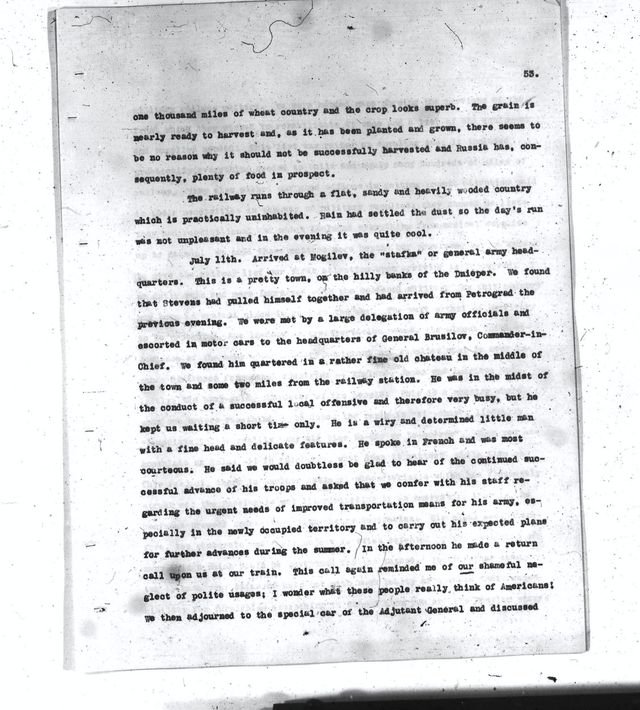
one thousand miles of wheat country and the crop looks superb. The grain is
nearly ready to harvest and, as it has been planted and grown, there seems to
be no reason why it should not be successfully harvested and Russia has, con-
sequently, plenty of food in prospect.
The railway runs through a flat, sandy and heavily wooded country
which is practically uninhabited. Rain had settled the dust so the day's run
was not unpleasant and in the evening it was quite cool.
July 11th. Arrived at Mogilev, the "stafka" or general army head-
quarters. This is a pretty town, on[?] the hilly banks of the Dnieper. We found
that Stevens had pulled himself together and had arrived from Petrograd the
previous evening. We were met by a large delegation of army officials and
escorted in motor cars to the headquarters of General Brusilov, Commander-in-
Chief. We found him quartered in a rather fine old chateau in the middle of
the town and some two miles from the railway station. He was in the midst of
the conduct of a successful local offensive and therefore very busy, but he
kept us waiting a short time only. He is a wiry and determined little man
with a fine head and delicate features. He spoke in French and was most
courteous. He said we would doubtless be glad to hear of the continued suc-
cessful advance of his troops and asked that we confer with his staff re-
garding the urgent needs of improved transportation means for his army, es-
pecially in the newly occupied territory and to carry out his expected plans
for further advances during the summer. In the afternoon he made a return
call upon us at our train. This call again reminded me of our shameful ne-
glect of polite usages; I wonder what these people really think of Americans!
We then adjourned to the special car of the Adjutant General and discussed
Wisconsin Historical Society · WHS-R3-594 · DUPLICATE microfilm exposure of frame 580 (document), (cont.)
Open the complete archive frame record →