
Read the original · Check the transcription
Gibbs Family Papers, Reel 3, frame 593 (reading copy)
Preserved transcription
Transcription matched to this Wisconsin microfilm frame. Preserved from the supplied frame transcription; compare uncertain readings with the scan.
52.
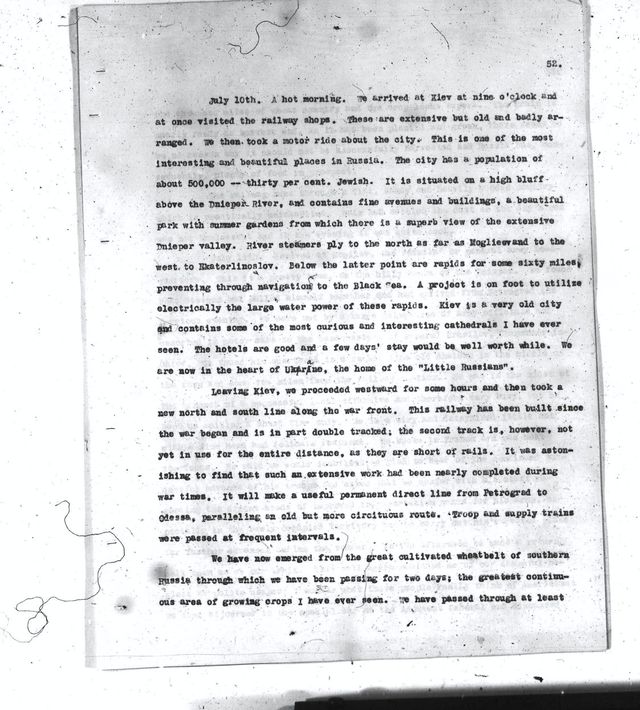
July 10th. A hot morning. We arrived at Kiev at nine o'clock and
at once visited the railway shops. These are extensive but old and badly ar-
ranged. We then took a motor ride about the city. This is one of the most
interesting and beautiful places in Russia. The city has a population of
about 500,000 -- thirty per cent. Jewish. It is situated on a high bluff
above the Dnieper River, and contains fine avenues and buildings, a beautiful
park with summer gardens from which there is a superb view of the extensive
Dnieper valley. River steamers ply to the north as far as Moglieev and to the
west to Ekaterlinoslov. Below the latter point are rapids for some sixty miles,
preventing through navigation to the Black Sea. A project is on foot to utilize
electrically the large water power of these rapids. Kiev is a very old city
and contains some of the most curious and interesting cathedrals I have ever
seen. The hotels are good and a few days' stay would be well worth while. We
are now in the heart of Ukr[inserted: a]ine, the home of the "Little Russians".
Leaving Kiev, we proceeded westward for some hours and then took a
new north and south line along the war front. This railway has been built since
the war began and is in part double tracked; the second track is, however, not
yet in use for the entire distance, as they are short of rails. It was aston-
ishing to find that such an extensive work had been nearly completed during
war times. It will make a useful permanent direct line from Petrograd to
Odessa, paralleling an old but more circituous route. Troop and supply trains
were passed at frequent intervals.
We have now emerged from the great cultivated wheatbelt of southern
Russia through which we have been passing for two days; the greatest continu-
ous area of growing crops I have ever seen. We have passed through at least
Wisconsin Historical Society · WHS-R3-593 · DUPLICATE microfilm exposure of frame 580 (document), (cont.)
Open the complete archive frame record →