
Read the original · Check the transcription
Gibbs Family Papers, Reel 3, frame 587 (reading copy)
Preserved transcription
Transcription matched to this Wisconsin microfilm frame. Preserved from the supplied frame transcription; compare uncertain readings with the scan.
[printed/typed page number: 46.]
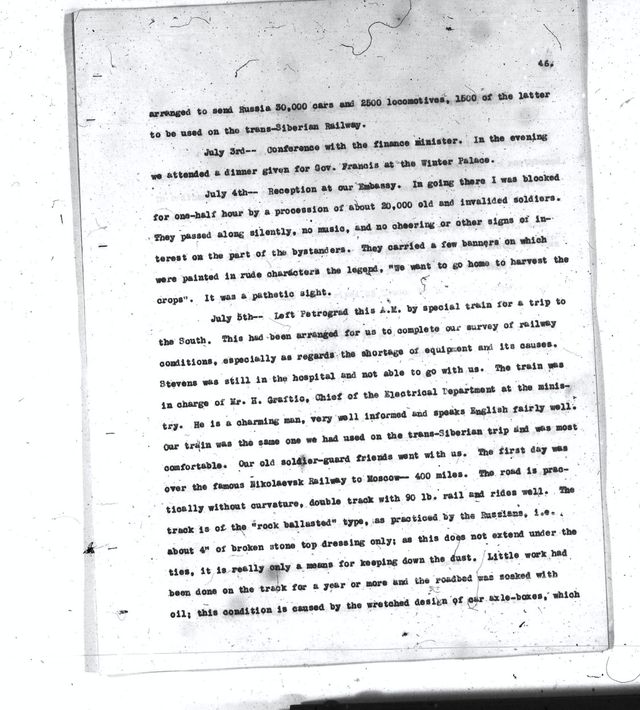
arranged to send Russia 30,000 cars and 2500 locomotives, 1500 of the latter
to be used on the trans-Siberian Railway.
July 3rd-- Conference with the finance minister. In the evening
we attended a dinner given for Gov. Francis at the Winter Palace.
July 4th-- Reception at our Embassy. In going there I was blocked
for one-half hour by a procession of about 20,000 old and invalided soldiers.
They passed along silently, no music, and no cheering or other signs of in-
terest on the part of the bystanders. They carried a few banners on which
were painted in rude characters the legend, "We[?] want to go home to harvest the
crops". It was a pathetic sight.
July 5th-- Left Petrograd this A.M. by special train for a trip to
the South. This had been arranged for us to complete our survey of railway
conditions, especially as regards the shortage of equipment and its causes.
Stevens was still in the hospital and not able to go with us. The train was
in charge of Mr. H. Graftio[?], Chief of the Electrical Department at the minis-
try. He is a charming man, very well informed and speaks English fairly well.
Our train was the same one we had used on the trans-Siberian trip and was most
comfortable. Our old soldier-guard friends went with us. The first day was
over the famous Nikolaevsk Railway to Moscow-- 400 miles. The road is prac-
tically without curvature, double track with 90 lb. rail and rides well. The
track is of the "rock ballasted" type, as practiced by the Russians, i.e.,
about 4" of broken stone top dressing only; as this does not extend under the
ties, it is really only a means for keeping down the dust. Little work had
been done on the track for a year or more and the roadbed was soaked with
oil; this condition is caused by the wretched design of car axle-boxes, which
Wisconsin Historical Society · WHS-R3-587 · DUPLICATE microfilm exposure of frame 580 (document), (cont.)
Open the complete archive frame record →