
Read the original · Check the transcription
Gibbs Family Papers, Reel 3, frame 584 (reading copy)
Preserved transcription
Transcription matched to this Wisconsin microfilm frame. Preserved from the supplied frame transcription; compare uncertain readings with the scan.
[printed: 42.]
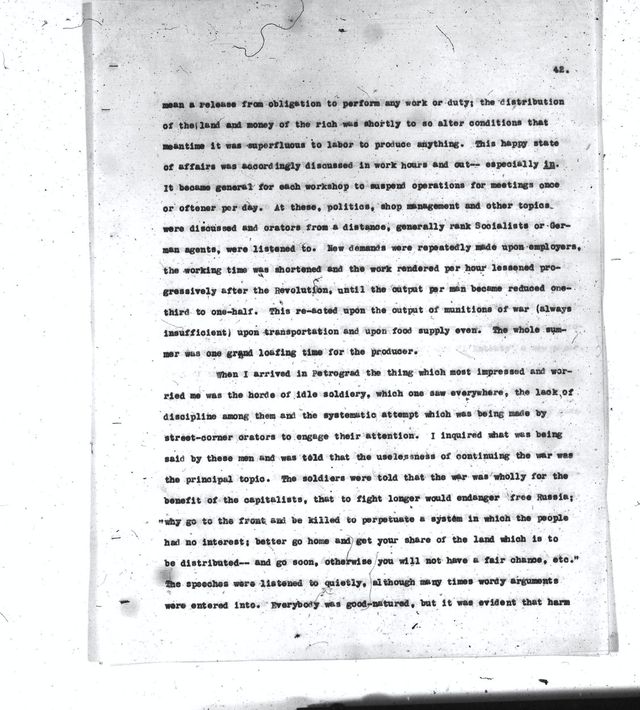
mean a release from obligation to perform any work or duty; the distribution
of the land and money of the rich was shortly to so alter conditions that
meantime it was superfluous to labor to produce anything. This happy state
of affairs was accordingly discussed in work hours and out-- especially in.
It became general for each workshop to suspend operations for meetings once
or oftener per day. At these, politics, shop management and other topics
were discussed and orators from a distance, generally rank Socialists or Ger-
man agents, were listened to. New demands were repeatedly made upon employers,
the working time was shortened and the work rendered per hour lessened pro-
gressively after the Revolution, until the output per man became reduced one-
third to one-half. This re-acted upon the output of munitions of war (always
insufficient) upon transportation and upon food supply even. The whole sum-
mer was one grand loafing time for the producer.
When I arrived in Petrograd the thing which most impressed and wor-
ried me was the horde of idle soldiery, which one saw everywhere, the lack of
discipline among them and the systematic attempt which was being made by
street-corner orators to engage their attention. I inquired what was being
said by these men and was told that the uselessness of continuing the war was
the principal topic. The soldiers were told that the war was wholly for the
benefit of the capitalists, that to fight longer would endanger free Russia;
"why go to the front and be killed to perpetuate a system in which the people
had no interest; better go home and get your share of the land which is to
be distributed-- and go soon, otherwise you will not have a fair chance, etc."
The speeches were listened to quietly, although many times wordy arguments
were entered into. Everybody was good-natured, but it was evident that harm
Wisconsin Historical Society · WHS-R3-584 · DUPLICATE microfilm exposure of frame 580 (document), (cont.)
Open the complete archive frame record →