
Read the original · Check the transcription
Gibbs Family Papers, Reel 2, frame 1706
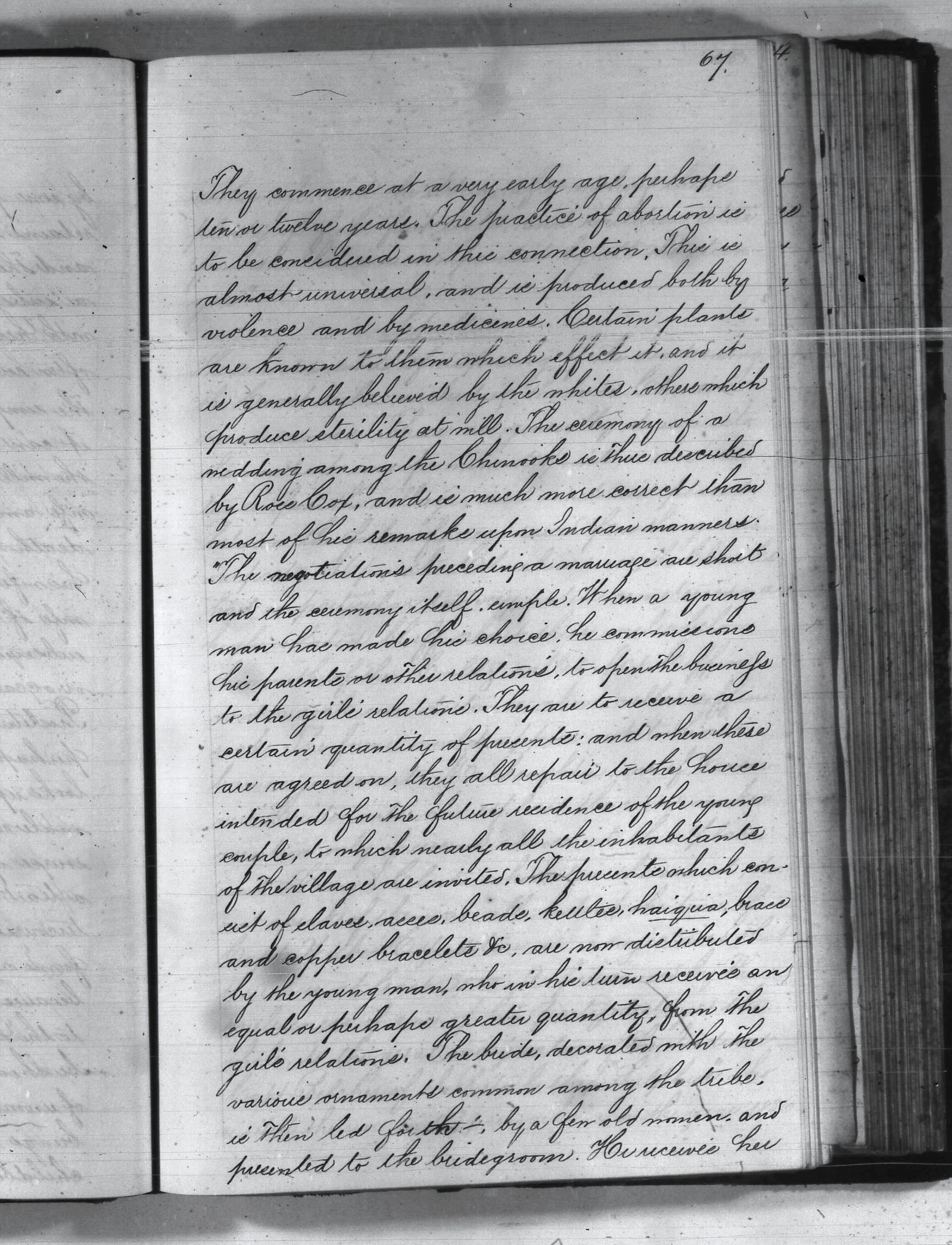
Preserved transcription
Transcription matched to this Wisconsin microfilm frame. Preserved from the supplied frame transcription; compare uncertain readings with the scan.
[printed/page no.: 67.]
They commence at a very early age, perhaps
ten or twelve years. The practice of abortion is
to be considered in this connection. This is
almost universal, and is produced both by
violence and by medicines. Certain plants
are known to them which effect it, and it
is generally believed by the whites, others which
produce sterility at will. The ceremony of a
wedding among the Chinooks is thus described
by Ross Cox, and is much more correct than
most of his remarks upon Indian manners.
"The negotiations preceding a marriage are short
and the ceremony itself, simple. When a young
man has made his choice, he commissions
his parents or other relations, to open the business
to the girls relations. They are to receive a
certain quantity of presents: and when these
are agreed on, they all repair to the house
intended for the future residence of the young
couple, to which nearly all the inhabitants
of the village are invited. The presents which con-
sist of slaves, axes, beads, kettles, haiqua, brass
and copper bracelets &c, are now distributed
by the young man, who in his turn receives an
equal or perhaps greater quantity, from the
girls relations. The bride, decorated with the
various ornaments common among the tribe,
is then led forth[?] [struck: illegible], by a few old women, and
presented to the bridegroom. He receives her
Wisconsin Historical Society · WHS-R2-1706 · George Gibbs ms. draft on Washington Territory Indians (notebook p.61) (document), n.d. (c.1854-57?)
Open the complete archive frame record →