
Read the original · Check the transcription
Gibbs Family Papers, Reel 3, frame 580 (reading copy)
Preserved transcription
Transcription matched to this Wisconsin microfilm frame. Preserved from the supplied frame transcription; compare uncertain readings with the scan.
40.
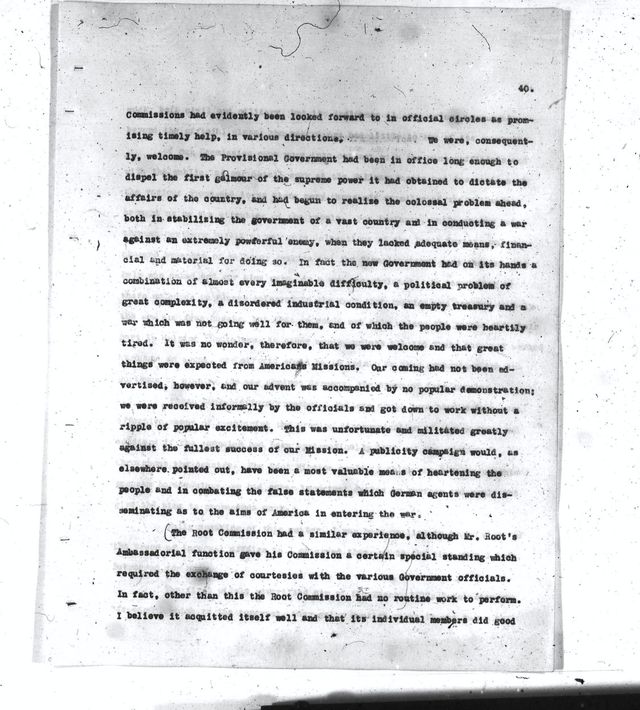
Commissions had evidently been looked forward to in official circles as prom-
ising timely help, in various directions, [struck: [illegible, ~2 words]] We were, consequent-
ly, welcome. The Provisional Government had been in office long enough to
dispel the first galmour of the supreme power it had obtained to dictate the
affairs of the country, and had begun to realize the colossal problem ahead,
both in stabilizing the government of a vast country and in conducting a war
against an extremely powferful[?] enemy, when they lacked adequate means, finan-
cial and material for doing so. In fact the new Government had on its hands a
combination of almost every imaginable difficulty, a political problem of
great complexity, a disordered industrial condition, an empty treasury and a
war which was not going well for them, and of which the people were heartily
tired. It was no wonder, therefore, that we were welcome and that great
things were expected from Americans[?] Missions. Our coming had not been ad-
vertised, however, and our advent was accompanied by no popular demonstration;
we were received informally by the officials and got down to work without a
ripple of popular excitement. This was unfortunate and militated greatly
against the fullest success of our Mission. A publicity campaign would, as
elsewhere pointed out, have been a most valuable means of heartening the
people and in combating the false statements which German agents were dis-
seminating as to the aims of America in entering the war.
(The Root Commission had a similar experience, although Mr. Root's
Ambassadorial function gave his Commission a certain special standing which
required the exchange of courtesies with the various Government officials.
In fact, other than this the Root Commission had no routine work to perform.
I believe it acquitted itself well and that its individual members did good
Wisconsin Historical Society · WHS-R3-580 · DUPLICATE microfilm exposure of frame 572 (document), (cont.)
Open the complete archive frame record →