
Read the original · Check the transcription
Gibbs Family Papers, Reel 3, frame 573 (reading copy)
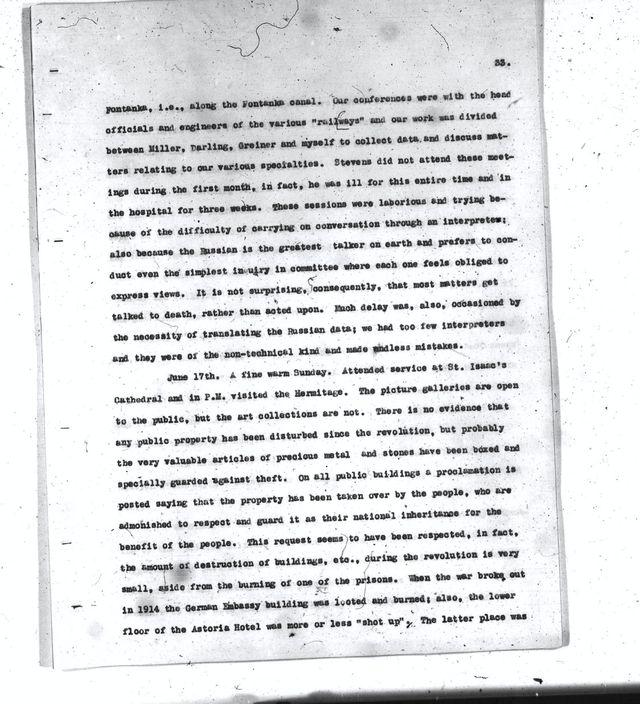
Preserved transcription
Transcription matched to this Wisconsin microfilm frame. Preserved from the supplied frame transcription; compare uncertain readings with the scan.
33.
Fontanka, i.e., along the Fontanka canal. Our conferences were with the head
officials and engineers of the various "railways" and our work was divided
between Miller, Darling, Greiner and myself to collect data and discuss mat-
ters relating to our various specialties. Stevens did not attend these meet-
ings during the first month, in fact, he was ill for this entire time and in
the hospital for three weeks. These sessions were laborious and trying be-
cause of the difficulty of carrying on conversation through an interpreter;
also because the Russian is the greatest talker on earth and prefers to con-
duct even the simplest inquiry in committee where each one feels obliged to
express views. It is not surprising, consequently, that most matters get
talked to death, rather than acted upon. Much delay was, also, occasioned by
the necessity of translating the Russian data; we had too few interpreters
and they were of the non-technical kind and made endless mistakes.
June 17th. A fine warm Sunday. Attended service at St. Isaac's
Cathedral and in P.M. visited the Hermitage. The picture galleries are open
to the public, but the art collections are not. There is no evidence that
any public property has been disturbed since the revolution, but probably
the very valuable articles of precious metal and stones have been boxed and
specially guarded against theft. On all public buildings a proclamation is
posted saying that the property has been taken over by the people, who are
admonished to respect and guard it as their national inheritance for the
benefit of the people. This request seems to have been respected, in fact,
the amount of destruction of buildings, etc., during the revolution is very
small, aside from the burning of one of the prisons. When the war broke out
in 1914 the German Embassy building was looted and burned; also, the lower
floor of the Astoria Hotel was more or less "shot up". The latter place was
Wisconsin Historical Society · WHS-R3-573 · DUPLICATE microfilm exposure of frame 572 (document), (cont.)
Open the complete archive frame record →