
Read the original · Check the transcription
Gibbs Family Papers, Reel 3, frame 562 (reading copy)
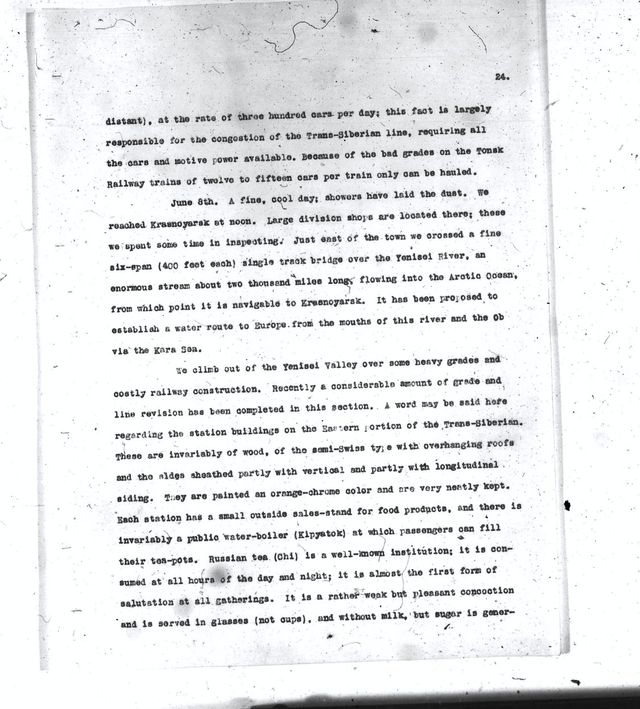
Preserved transcription
Transcription matched to this Wisconsin microfilm frame. Preserved from the supplied frame transcription; compare uncertain readings with the scan.
24.
distant), at the rate of three hundred cars per day; this fact is largely
responsible for the congestion of the Trans-Siberian line, requiring all
the cars and motive power available. Because of the bad grades on the Tonsk
Railway trains of twelve to fifteen cars per train only can be hauled.
June 8th. A fine, cool day; showers have laid the dust. We
reached Krasnoyarsk at noon. Large division shops are located there; these
we spent some time in inspecting. Just east of the town we crossed a fine
six-span (400 feet each) single track bridge over the Yenisei River, an
enormous stream about two thousand miles long, flowing into the Arctic Ocean,
from which point it is navigable to Krasnoyarsk. It has been proposed to
establish a water route to Europe from the mouths of this river and the Ob
via the Kara Sea.
We climb out of the Yenisei Valley over some heavy grades and
costly railway construction. Recently a considerable amount of grade and
line revision has been completed in this section. A word may be said here
regarding the station buildings on the Eastern portion of the Trans-Siberian.
These are invariably of wood, of the semi-Swiss type with overhanging roofs
and the sides sheathed partly with vertical and partly with longitudinal
siding. They are painted an orange-chrome color and are very neatly kept.
Each station has a small outside sales-stand for food products, and there is
invariably a public water-boiler (Kipyatok) at which passengers can fill
their tea-pots. Russian tea (Chi) is a well-known institution; it is con-
sumed at all hours of the day and night; it is almost the first form of
salutation at all gatherings. It is a rather weak but pleasant concoction
and is served in glasses (not cups), and without milk, but sugar is gener-
Wisconsin Historical Society · WHS-R3-562 · DUPLICATE microfilm exposure of frame 557 (document), (cont.)
Open the complete archive frame record →