
Read the original · Check the transcription
Gibbs Family Papers, Reel 3, frame 554 (reading copy)
Preserved transcription
Transcription matched to this Wisconsin microfilm frame. Preserved from the supplied frame transcription; compare uncertain readings with the scan.
[printed: none] 17.
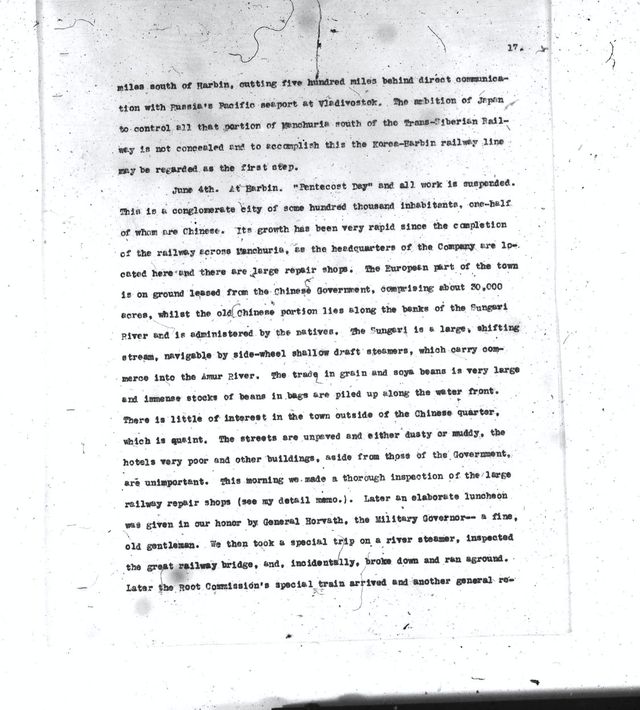
miles south of Harbin, cutting five hundred miles behind direct communica-
tion with Russia's Pacific seaport at Vladivostok. The ambition of Japan
to control all that portion of Manchuria south of the Trans-Siberian Rail-
way is not concealed and to accomplish this the Korea-Harbin railway line
may be regarded as the first step.
June 4th. At Harbin. "Pentecost Day" and all work is suspended.
This is a conglomerate city of some hundred thousand inhabitants, one-half
of whom are Chinese. Its growth has been very rapid since the completion
of the railway across Manchuria, as the headquarters of the Company are lo-
cated here and there are large repair shops. The European part of the town
is on ground leased from the Chinese Government, comprising about 30,000
acres, whilst the old Chinese portion lies along the banks of the Sungari
River and is administered by the natives. The Sungari is a large, shifting
stream, navigable by side-wheel shallow draft steamers, which carry com-
merce into the Amur River. The trade in grain and soya beans is very large
and immense stocks of beans in bags are piled up along the water front.
There is little of interest in the town outside of the Chinese quarter,
which is quaint. The streets are unpaved and either dusty or muddy, the
hotels very poor and other buildings, aside from those of the Government,
are unimportant. This morning we made a thorough inspection of the large
railway repair shops (see my detail memo.). Later an elaborate luncheon
was given in our honor by General Horvath, the Military Governor-- a fine,
old gentleman. We then took a special trip on a river steamer, inspected
the great railway bridge, and, incidentally, broke down and ran aground.
Later the Root Commission's special train arrived and another general re-
Wisconsin Historical Society · WHS-R3-554 · DUPLICATE microfilm exposure of frame 541 (document), (cont.)
Open the complete archive frame record →