
Read the original · Check the transcription
Gibbs Family Papers, Reel 3, frame 553 (reading copy)
Preserved transcription
Transcription matched to this Wisconsin microfilm frame. Preserved from the supplied frame transcription; compare uncertain readings with the scan.
16.
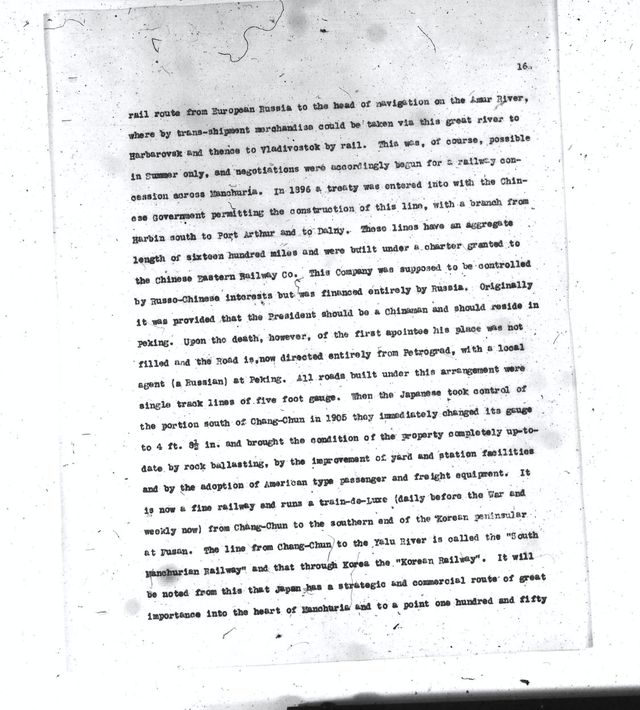
rail route from European Russia to the head of navigation on the Amur River,
where by trans-shipment merchandise could be taken via this great river to
Harbarovsk and thence to Vladivostok by rail. This was, of course, possible
in Summer only, and negotiations were accordingly begun for a railway con-
cession across Manchuria. In 1896 a treaty was entered into with the Chin-
ese Government permitting the construction of this line, with a branch from
Harbin south to Port Arthur and to Dalny. These lines have an aggregate
length of sixteen hundred miles and were built under a charter granted to
the Chinese Eastern Railway Co. This Company was supposed to be controlled
by Russo-Chinese interests but was financed entirely by Russia. Originally
it was provided that the President should be a Chinaman and should reside in
Peking. Upon the death, however, of the first apointee his place was not
filled and the Road is,now directed entirely from Petrograd, with a local
agent (a Russian) at Peking. All roads built under this arrangement were
single track lines of five foot gauge. When the Japanese took control of
the portion south of Chang-Chun in 1905 they immediately changed its gauge
to 4 ft. 8½ in. and brought the condition of the property completely up-to-
date by rock ballasting, by the improvement of yard and station facilities
and by the adoption of American type passenger and freight equipment. It
is now a fine railway and runs a train-de-Luxe (daily before the War and
weekly now) from Chang-Chun to the southern end of the Korean peninsular
at Fusan. The line from Chang-Chun to the Yalu River is called the "South
Manchurian Railway" and that through Korea the "Korean Railway". It will
be noted from this that Japan has a strategic and commercial route of great
importance into the heart of Manchuria and to a point one hundred and fifty
Wisconsin Historical Society · WHS-R3-553 · DUPLICATE microfilm exposure of frame 541 (document), (cont.)
Open the complete archive frame record →