
Read the original · Check the transcription
Gibbs Family Papers, Reel 3, frame 552 (reading copy)
Preserved transcription
Transcription matched to this Wisconsin microfilm frame. Preserved from the supplied frame transcription; compare uncertain readings with the scan.
15.
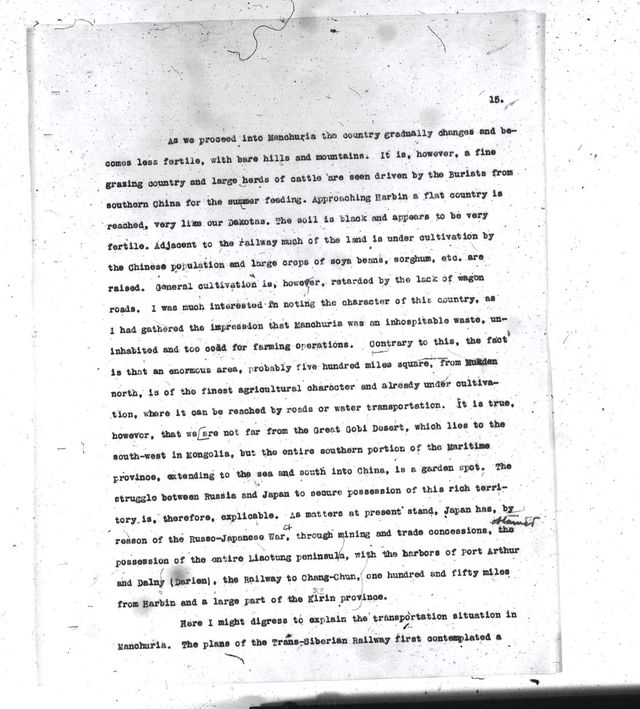
As we proceed into Manchuria the country gradually changes and be-
comes less fertile, with bare hills and mountains. It is, however, a fine
grazing country and large herds of cattle are seen driven by the Buriats from
southern China for the summer feeding. Approaching Harbin a flat country is
reached, very like[?] our Dakotas. The soil is black and appears to be very
fertile. Adjacent to the railway much of the land is under cultivation by
the Chinese population and large crops of soya beans, sorghum, etc. are
raised. General cultivation is, however, retarded by the lack of wagon
roads. I was much interested in noting the character of this country, as
I had gathered the impression that Manchuria was an inhospitable waste, un-
inhabited and too codd for farming operations. Contrary to this, the fact
is that an enormous area, probably five hundred miles square, from Mukden
north, is of the finest agricultural character and already under cultiva-
tion, where it can be reached by roads or water transportation. It is true,
however, that we are not far from the Great Gobi Desert, which lies to the
south-west in Mongolia, but the entire southern portion of the Maritime
province, extending to the sea and south into China, is a garden spot. The
struggle between Russia and Japan to secure possession of this rich terri-
tory is, therefore, explicable. As matters at present stand, Japan has, by [inserted in right margin, in pen: [illegible, ~1 word]]
reason of the Russo-Japanese War, through mining and trade concessions, the
possession of the entire Liaotung peninsula, with the harbors of Port Arthur
and Dalny (Darien), the Railway to Chang-Chun, one hundred and fifty miles
from Harbin and a large part of the Kirin province.
Here I might digress to explain the transportation situation in
Manchuria. The plans of the Trans-Siberian Railway first contemplated a
Wisconsin Historical Society · WHS-R3-552 · DUPLICATE microfilm exposure of frame 541 (document), (cont.)
Open the complete archive frame record →