
Read the original · Check the transcription
Gibbs Family Papers, Reel 3, frame 529 (reading copy)
Preserved transcription
Transcription matched to this Wisconsin microfilm frame. Preserved from the supplied frame transcription; compare uncertain readings with the scan.
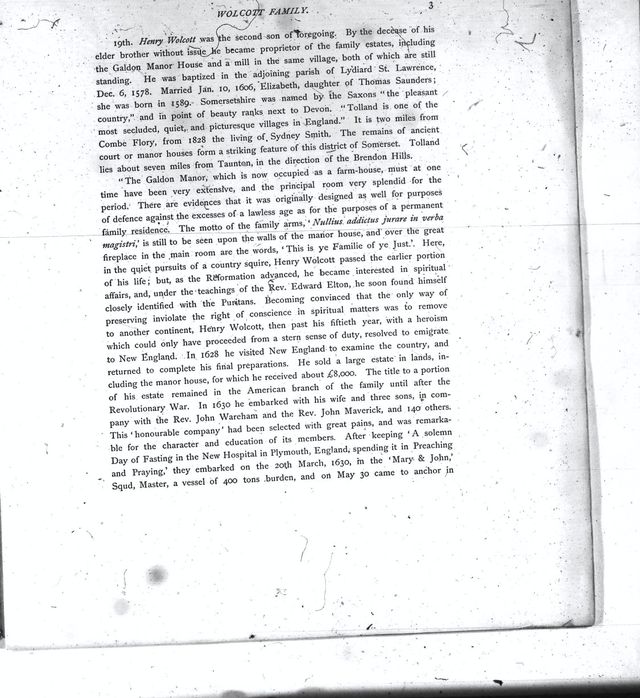
[printed: WOLCOTT FAMILY. 3
19th. Henry Wolcott was the second son of foregoing. By the decease of his
elder brother without issue he became proprietor of the family estates, including
the Galdon Manor House and a mill in the same village, both of which are still
standing. He was baptized in the adjoining parish of Lydiard St. Lawrence,
Dec. 6, 1578. Married Jan. 10, 1606, Elizabeth, daughter of Thomas Saunders;
she was born in 1589. Somersetshire was named by the Saxons "the pleasant
country," and in point of beauty ranks next to Devon. "Tolland is one of the
most secluded, quiet, and picturesque villages in England." It is two miles from
Combe Flory, from 1828 the living of Sydney Smith. The remains of ancient
court or manor houses form a striking feature of this district of Somerset. Tolland
lies about seven miles from Taunton, in the direction of the Brendon Hills.
"The Galdon Manor, which is now occupied as a farm-house, must at one
time have been very extensive, and the principal room very splendid for the
period. There are evidences that it was originally designed as well for purposes
of defence against the excesses of a lawless age as for the purposes of a permanent
family residence. The motto of the family arms, 'Nullius addictus jurare in verba
magistri,' is still to be seen upon the walls of the manor house, and over the great
fireplace in the main room are the words, 'This is ye Familie of ye Just.'. Here,
in the quiet pursuits of a country squire, Henry Wolcott passed the earlier portion
of his life; but, as the Reformation advanced, he became interested in spiritual
affairs, and, under the teachings of the Rev. Edward Elton, he soon found himself
closely identified with the Puritans. Becoming convinced that the only way of
preserving inviolate the right of conscience in spiritual matters was to remove
to another continent, Henry Wolcott, then past his fiftieth year, with a heroism
which could only have proceeded from a stern sense of duty, resolved to emigrate
to New England. In 1628 he visited New England to examine the country, and
returned to complete his final preparations. He sold a large estate in lands, in-
cluding the manor house, for which he received about £8,000. The title to a portion
of his estate remained in the American branch of the family until after the
Revolutionary War. In 1630 he embarked with his wife and three sons, in com-
pany with the Rev. John Wareham and the Rev. John Maverick, and 140 others.
This 'honourable company' had been selected with great pains, and was remarka-
ble for the character and education of its members. After keeping 'A solemn
Day of Fasting in the New Hospital in Plymouth, England, spending it in Preaching
and Praying,' they embarked on the 20th March, 1630, in the 'Mary & John,'
Squd[?], Master, a vessel of 400 tons burden, and on May 30 came to anchor in]
Wisconsin Historical Society · WHS-R3-529 · Printed book, The Wolcott Memorial
Open the complete archive frame record →