
Read the original · Check the transcription
Gibbs Family Papers, Reel 3, frame 518 (reading copy)
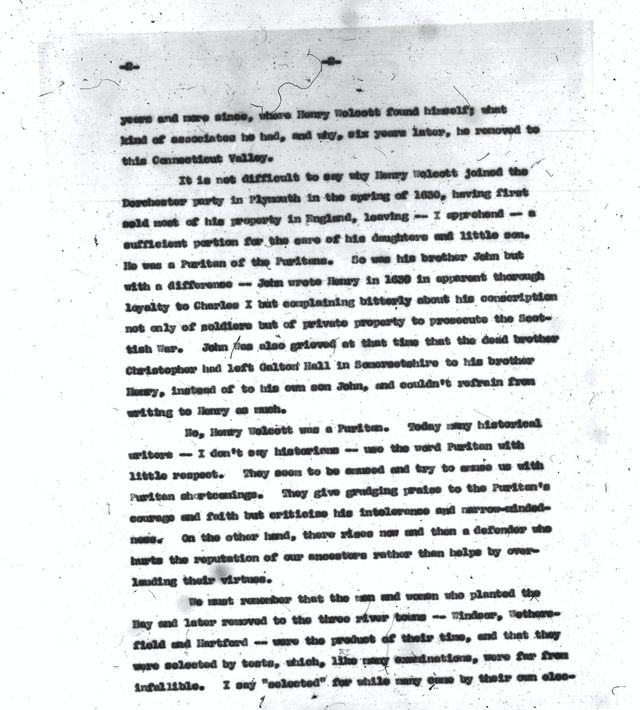
Preserved transcription
Transcription matched to this Wisconsin microfilm frame. Preserved from the supplied frame transcription; compare uncertain readings with the scan.
-2- -2-
years and more since, where Henry Wolcott found himself; what
kind of associates he had, and why, six years later, he removed to
this Connecticut Valley.
It is not difficult to say why Henry Wolcott joined the
Dorchester party in Plymouth in the spring of 1630, having first
sold most of his property in England, leaving -- I apprehend -- a
sufficient portion for the care of his daughters and little son.
He was a Puritan of the Puritans. So was his brother John but
with a difference -- John wrote Henry in 1639 in apparent thorough
loyalty to Charles I but complaining bitterly about his conscription
not only of soldiers but of private property to prosecute the Scot-
tish War. John was also grieved at that time that the dead brother
Christopher had left Galton[?] Hall in Somersetshire to his brother
Henry, instead of to his own son John, and couldn't refrain from
writing to Henry as much.
No,[?] Henry Wolcott was a Puritan. Today many historical
writers -- I don't say historians -- use the word Puritan with
little respect. They seem to be amused and try to amuse us with
Puritan shortcomings. They give grudging praise to the Puritan's
courage and faith but criticise his intolerance and narrow-minded-
ness. On the other hand, there rises now and then a defender who
hurts the reputation of our ancestors rather than helps by over-
lauding their virtues.
We must remember that the men and women who planted the
Bay and later removed to the three river towns -- Windsor, Wethers-
field and Hartford -- were the product of their time, and that they
were selected by tests, which, like many examinations, were far from
infallible. I say "selected" for while many came by their own elec-
Wisconsin Historical Society · WHS-R3-518 · Letter from Mr. Shipman (Hartford) to Society of Descendants of Henry Wolcott, n.d. (enclosure)
Open the complete archive frame record →