
Read the original · Check the transcription
Gibbs Family Papers, Reel 3, frame 515 (reading copy)
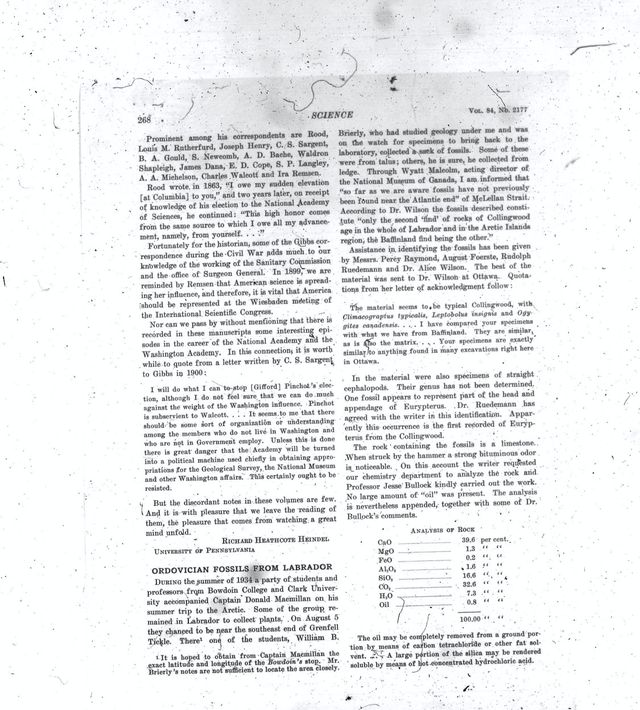
Preserved transcription
Transcription matched to this Wisconsin microfilm frame. Preserved from the supplied frame transcription; compare uncertain readings with the scan.
268 SCIENCE VOL. 84, No. 2177
Prominent among his correspondents are Rood,
Louis M. Rutherfurd, Joseph Henry, C. S. Sargent,
B. A. Gould, S. Newcomb, A. D. Bache, Waldron
Shapleigh, James Dana, E. D. Cope, S. P. Langley,
A. A. Michelson, Charles Walcott and Ira Remsen.
Rood wrote in 1863, "I owe my sudden elevation
[at Columbia] to you," and two years later, on receipt
of knowledge of his election to the National Academy
of Sciences, he continued: "This high honor comes
from the same source to which I owe all my advance-
ment, namely, from yourself. . . ."
Fortunately for the historian, some of the Gibbs cor-
respondence during the Civil War adds much to our
knowledge of the working of the Sanitary Commission
and the office of Surgeon General. In 1899, we are
reminded by Remsen that American science is spread-
ing her influence, and therefore, it is vital that America
should be represented at the Wiesbaden meeting of
the International Scientific Congress.
Nor can we pass by without mentioning that there is
recorded in these manuscripts some interesting epi-
sodes in the career of the National Academy and the
Washington Academy. In this connection, it is worth
while to quote from a letter written by C. S. Sargent
to Gibbs in 1900:
I will do what I can to stop [Gifford] Pinchot's elec-
tion, although I do not feel sure that we can do much
against the weight of the Washington influence. Pinchot
is subservient to Walcott. . . . It seems to me that there
should be some sort of organization or understanding
among the members who do not live in Washington and
who are not in Government employ. Unless this is done
there is great danger that the Academy will be turned
into a political machine used chiefly in obtaining appro-
priations for the Geological Survey, the National Museum
and other Washington affairs. This certainly ought to be
resisted.
But the discordant notes in these volumes are few.
And it is with pleasure that we leave the reading of
them, the pleasure that comes from watching a great
mind unfold.
RICHARD HEATHCOTE HEINDEL
UNIVERSITY OF PENNSYLVANIA
ORDOVICIAN FOSSILS FROM LABRADOR
DURING the summer of 1934 a party of students and
professors from Bowdoin College and Clark Univer-
sity accompanied Captain Donald Macmillan on his
summer trip to the Arctic. Some of the group re-
mained in Labrador to collect plants. On August 5
they chanced to be near the southeast end of Grenfell
Tickle. There¹ one of the students, William B.
¹ It is hoped to obtain from Captain Macmillan the
exact latitude and longitude of the *Bowdoin's* stop. Mr.
Brierly's notes are not sufficient to locate the area closely.
[right-hand column]
Brierly, who had studied geology under me and was
on the watch for specimens to bring back to the
laboratory, collected a sack of fossils. Some of these
were from talus; others, he is sure, he collected from
ledge. Through Wyatt Malcolm, acting director of
the National Museum of Canada, I am informed that
"so far as we are aware fossils have not previously
been found near the Atlantic end" of McLellan Strait.
According to Dr. Wilson the fossils described consti-
tute "only the second 'find' of rocks of Collingwood
age in the whole of Labrador and in the Arctic Islands
region, the Baffinland find being the other."
Assistance in identifying the fossils has been given
by Messrs. Percy Raymond, August Foerste, Rudolph
Ruedemann and Dr. Alice Wilson. The best of the
material was sent to Dr. Wilson at Ottawa. Quota-
tions from her letter of acknowledgment follow:
The material seems to be typical Collingwood, with
*Climacograptus typicalis, Leptobolus insignis* and *Ogy-
gites canadensis*. . . . I have compared your specimens
with what we have from Baffinland. They are similar,
as is also the matrix. . . . Your specimens are exactly
similar to anything found in many excavations right here
in Ottawa.
In the material were also specimens of straight
cephalopods. Their genus has not been determined.
One fossil appears to represent part of the head and
appendage of Eurypterus. Dr. Ruedemann has
agreed with the writer in this identification. Appar-
ently this occurrence is the first recorded of Euryp-
terus from the Collingwood.
The rock containing the fossils is a limestone.
When struck by the hammer a strong bituminous odor
is noticeable. On this account the writer requested
our chemistry department to analyze the rock and
Professor Jesse Bullock kindly carried out the work.
No large amount of "oil" was present. The analysis
is nevertheless appended, together with some of Dr.
Bullock's comments.
ANALYSIS OF ROCK
CaO ................ 39.6 per cent.
MgO ................ 1.3 " "
FeO ................ 0.2 " "
Al₂O₃ ................ 1.6 " "
SiO₂ ................ 16.6 " "
CO₂ ................ 32.6 " "
H₂O ................ 7.3 " "
Oil ................ 0.8 " "
______
100.00 " "
The oil may be completely removed from a ground por-
tion by means of carbon tetrachloride or other fat sol-
vent. . . . A large portion of the silica may be rendered
soluble by means of hot concentrated hydrochloric acid.
Wisconsin Historical Society · WHS-R3-515 · DUPLICATE microfilm exposure of frame 513 (document), (cont.)
Open the complete archive frame record →