
Read the original · Check the transcription
Gibbs Family Papers, Reel 2, frame 1672
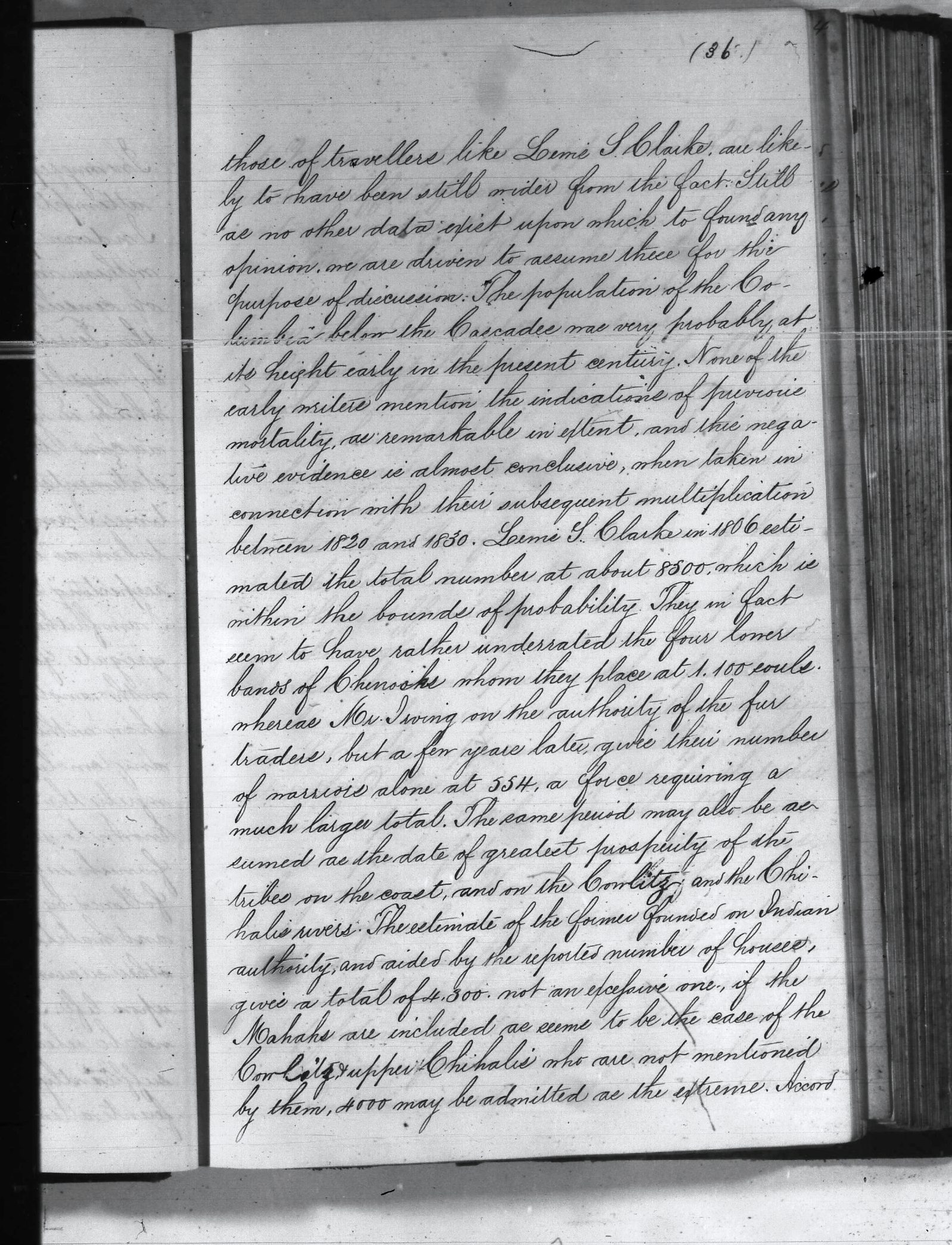
Preserved transcription
Transcription matched to this Wisconsin microfilm frame. Preserved from the supplied frame transcription; compare uncertain readings with the scan.
[page number, top right:] (36.)
those of travellers like Lewis & Clarke, are like-
ly to have been still wider from the fact. Still
as no other data exist upon which to found any
opinion, we are driven to assume these for the
purpose of discussion. The population of the Co-
lumbia below the Cascades was very probably, at
its height early in the present century. None of the
early writers mention the indications of previous
mortality, as remarkable in extent, and this nega-
tive evidence is almost conclusive, when taken in
connection with their subsequent multiplication
between 1820 and 1830. Lewis & Clarke in 1806 esti-
mated the total number at about 8500, which is
within the bounds of probability. They in fact
seem to have rather underrated the four lower
bands of Chinooks whom they place at 1.100 souls.
whereas Mr. Irving on the authority of the fur
traders, but a few years later, gives their number
of warriors alone at 554, a force requiring a
much larger total. The same period may also be as-
sumed as the date of greatest prosperity of the
tribes on the coast, and on the Cowlitz[?], and the Chi-
halis rivers. The estimate of the former founded on Indian
authority, and aided by the reported number of houses,
gives a total of 4.300. not an excessive one, if the
Makahs[?] are included as seems to be the case of the
Cowlitz & upper Chihalis who are not mentioned
by them, 4000 may be admitted as the extreme. Accord
Wisconsin Historical Society · WHS-R2-1672 · George Gibbs manuscript, ethnography of Washington Territory Indians (notebook p.29), n.d. [c.1856]
Open the complete archive frame record →