
Read the original · Check the transcription
Gibbs Family Papers, Reel 2, frame 1660
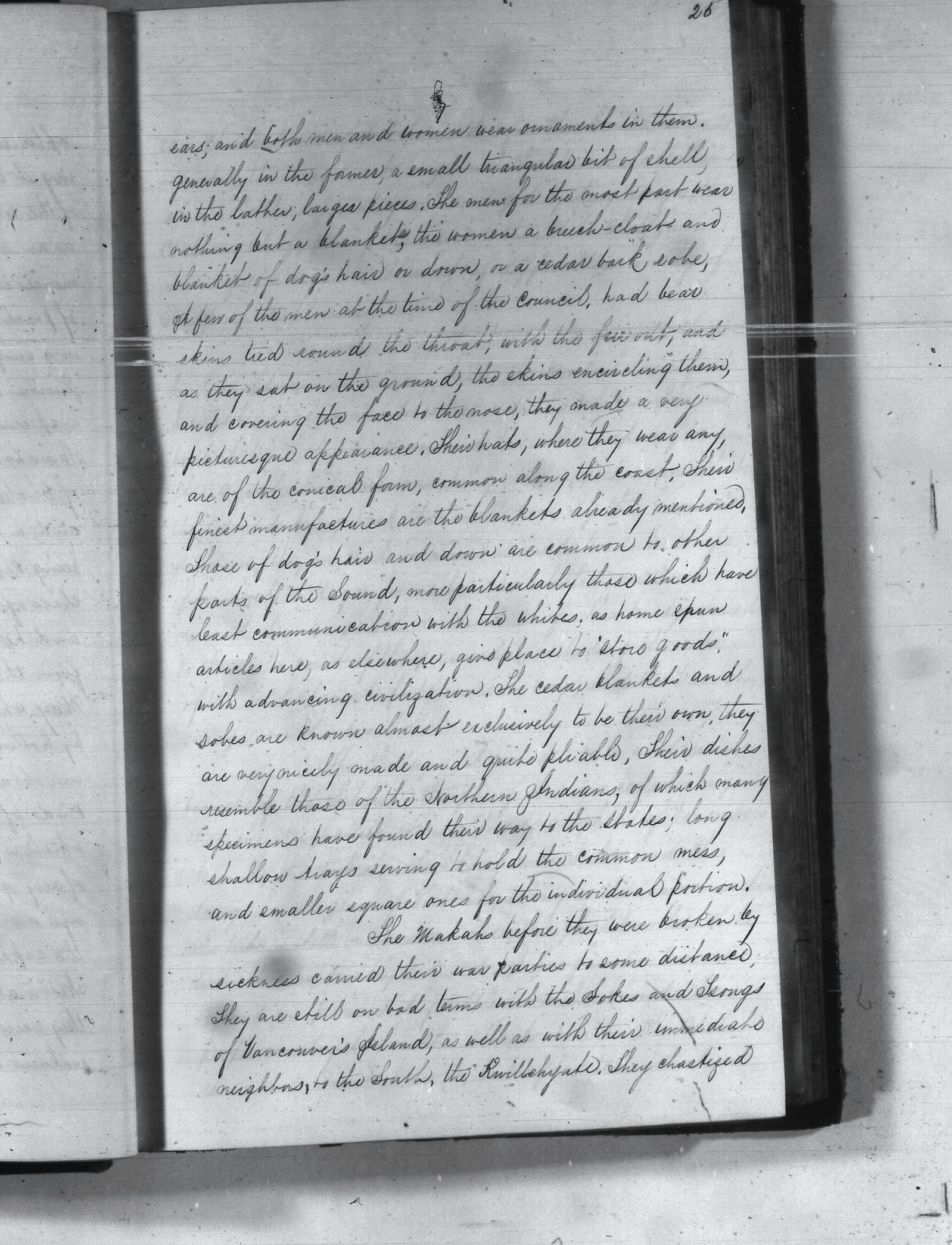
Preserved transcription
Transcription matched to this Wisconsin microfilm frame. Preserved from the supplied frame transcription; compare uncertain readings with the scan.
[page number, top right:] 26
[small pen mark or flourish, top centre]
ears; and both men and women wear ornaments in them.
generally in the former, a small triangular bit of shell,
in the latter, larger pieces. The men for the most part wear
nothing but a blanket; the women a breech-cloat[?] and
blanket of dog's hair or down, or a cedar bark robe,
A few of the men at the time of the council, had bear
skins tied round the throat, with the fur out; and
as they sat on the ground, the skins encircling them,
and covering the face to the nose, they made a very
picturesque appearance. Their hats, where they wear any,
are of the conical form, common along the coast; Their
finest manufactures are the blankets already mentioned,
Those of dog's hair and down are common to other
parts of the Sound, more particularly those which have
least communication with the whites, as home spun
articles here, as elsewhere, give place to "store goods"
with advancing civilization. The cedar blankets and
robes are known almost exclusively to be their own; they
are very nicely made and quite pliable, Their dishes
resemble those of the Northern Indians, of which many
specimens have found their way to the States; long
shallow trays serving to hold the common mess,
and smaller square ones for the individual portion.
The Makahs before they were broken by
sickness carried their war parties to some distance,
They are still on bad terms with the Sokes and Songs[?]
of Vancouver's Island, as well as with their immediate
neighbors, to the South, the Kwillehyute. They chastized
Wisconsin Historical Society · WHS-R2-1660 · George Gibbs IV ethnographic ms., notebook p.13 (document), c.1856
Open the complete archive frame record →