
Read the original · Check the transcription
Gibbs Family Papers, Reel 2, frame 1659
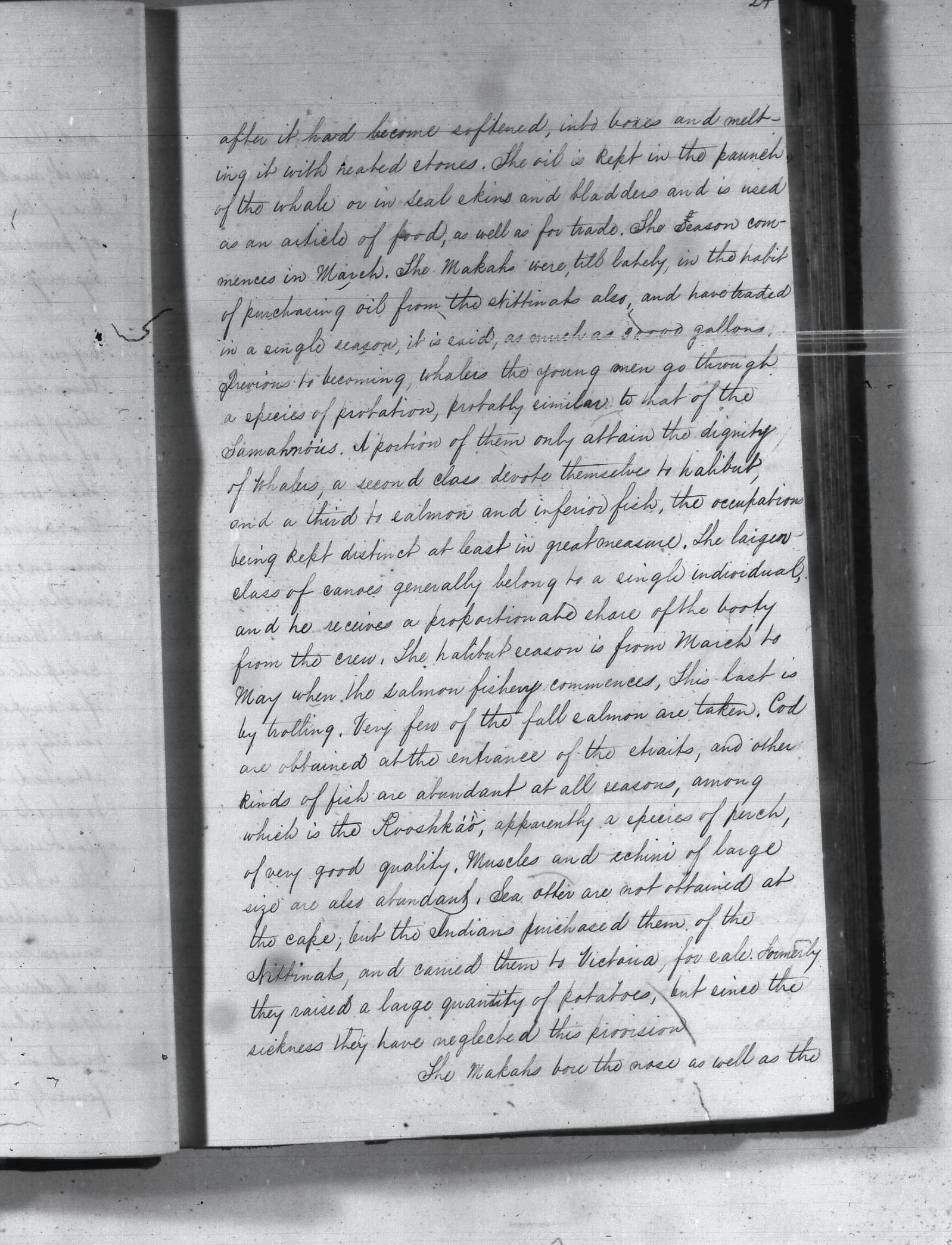
Preserved transcription
Transcription matched to this Wisconsin microfilm frame. Preserved from the supplied frame transcription; compare uncertain readings with the scan.
24[?]
after it had become softened, into boxes and melt-
ing it with heated stones. The oil is kept in the paunch
of the whale or in seal skins and bladders and is used
as an article of food, as well as for trade. The Season com-
mences in March. The Makahs were, till lately, in the habit
of purchasing oil from the Nittinats also, and have traded
in a single season, it is said, as much as 3000[?] gallons.
Previous to becoming, whalers the young men go through
a species of probation, probably similar to that of the
Tamahnous[?]. A portion of them only attain the dignity
of whalers, a second class devote themselves to halibut,
and a third to salmon and inferior fish, the occupations
being kept distinct at least in great measure. The larger
class of canoes generally belong to a single individual,
and he receives a proportionate share of the booty
from the crew. The halibut season is from March to
May when the salmon fishery commences, This last is
by trolling. Very few of the fall salmon are taken. Cod
are obtained at the entrance of the straits, and other
kinds of fish are abundant at all seasons, among
which is the Kooshkäö[?], apparently a species of perch,
of very good quality. Muscles and echini of large
size are also abundant. Sea otter are not obtained at
the cape; but the Indians purchased them of the
Nittinats, and carried them to Victoria, for sale. Formerly
they raised a large quantity of potatoes, but since the
sickness they have neglected this provision
The Makahs bore the nose as well as the
Wisconsin Historical Society · WHS-R2-1659 · George Gibbs IV ethnographic ms., notebook p.13 (document), c.1856
Open the complete archive frame record →