
Read the original · Check the transcription
Gibbs Family Papers, Reel 2, frame 1658
Preserved transcription
Transcription matched to this Wisconsin microfilm frame. Preserved from the supplied frame transcription; compare uncertain readings with the scan.
[page number, top right corner, partly cut off: 28[?]]
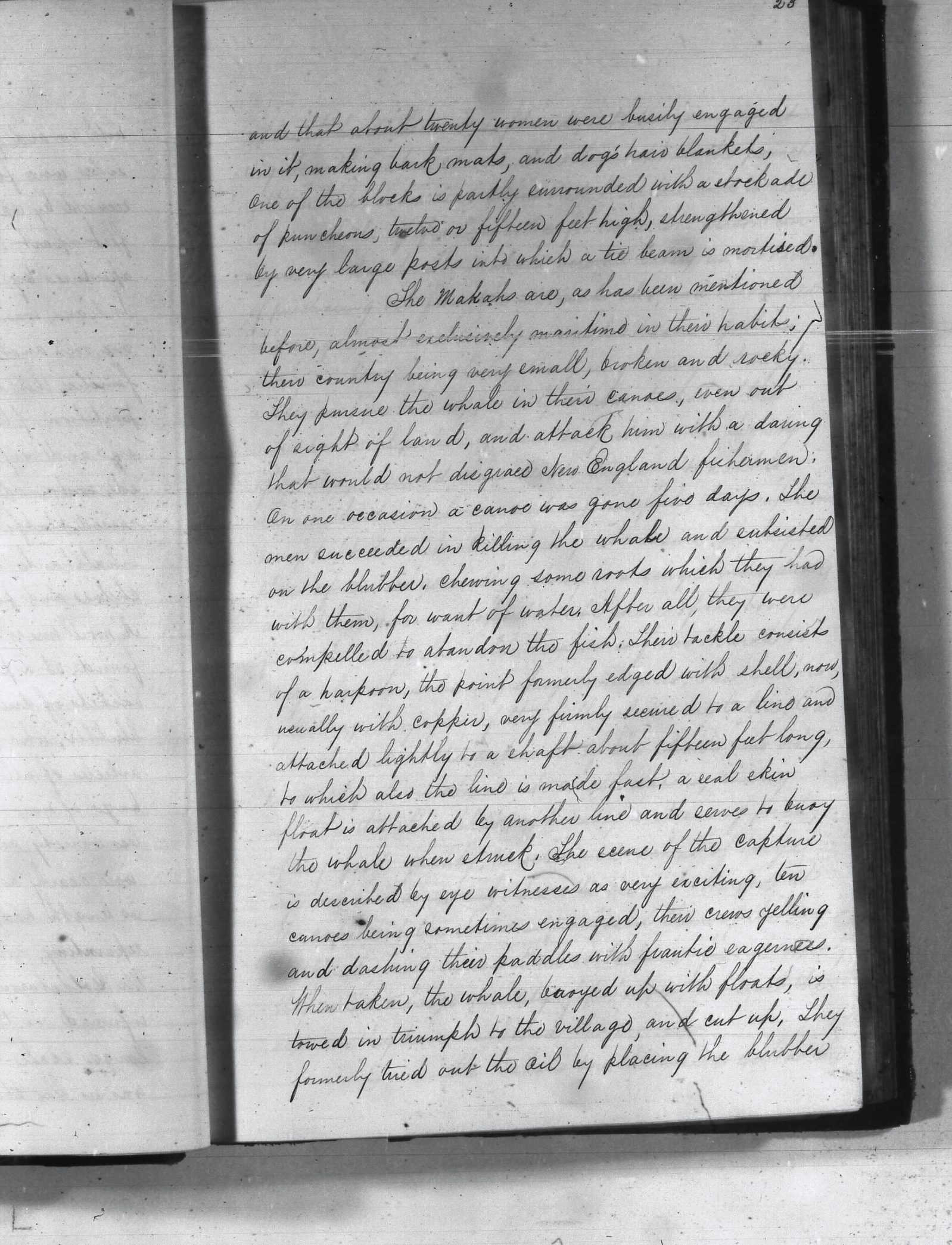
and that about twenty women were busily engaged
in it, making bark mats, and dog's hair blankets,
One of the blocks[?] is partly surrounded with a stockade
of puncheons, twelve or fifteen feet high, strengthened
by very large posts into which a tie beam is mortised.
The Makahs are, as has been mentioned
before, almost exclusively maritime in their habits;
their country being very small, broken and rocky.
They pursue the whale in their canoes, even out
of sight of land, and attack him with a daring
that would not disgrace New England fishermen.
On one occasion a canoe was gone five days. The
men succeeded in killing the whale and subsisted
on the blubber, chewing some roots which they had
with them, for want of water. After all, they were
compelled to abandon the fish. Their tackle consists
of a harpoon, the point formerly edged with shell, now,
usually with copper, very firmly secured to a line and
attached lightly to a shaft about fifteen feet long,
to which also the line is made fast, a seal skin
float is attached by another line and serves to buoy
the whale when struck. The scene of the capture
is described by eye witnesses as very exciting, ten
canoes being sometimes engaged, their crews yelling
and dashing their paddles with frantic eagerness.
When taken, the whale, buoyed up with floats, is
towed in triumph to the village, and cut up. They
formerly tried out the oil by placing the blubber
Wisconsin Historical Society · WHS-R2-1658 · George Gibbs IV ethnographic ms., notebook p.13 (document), c.1856
Open the complete archive frame record →