
Read the original · Check the transcription
Gibbs Family Papers, Reel 2, frame 1653
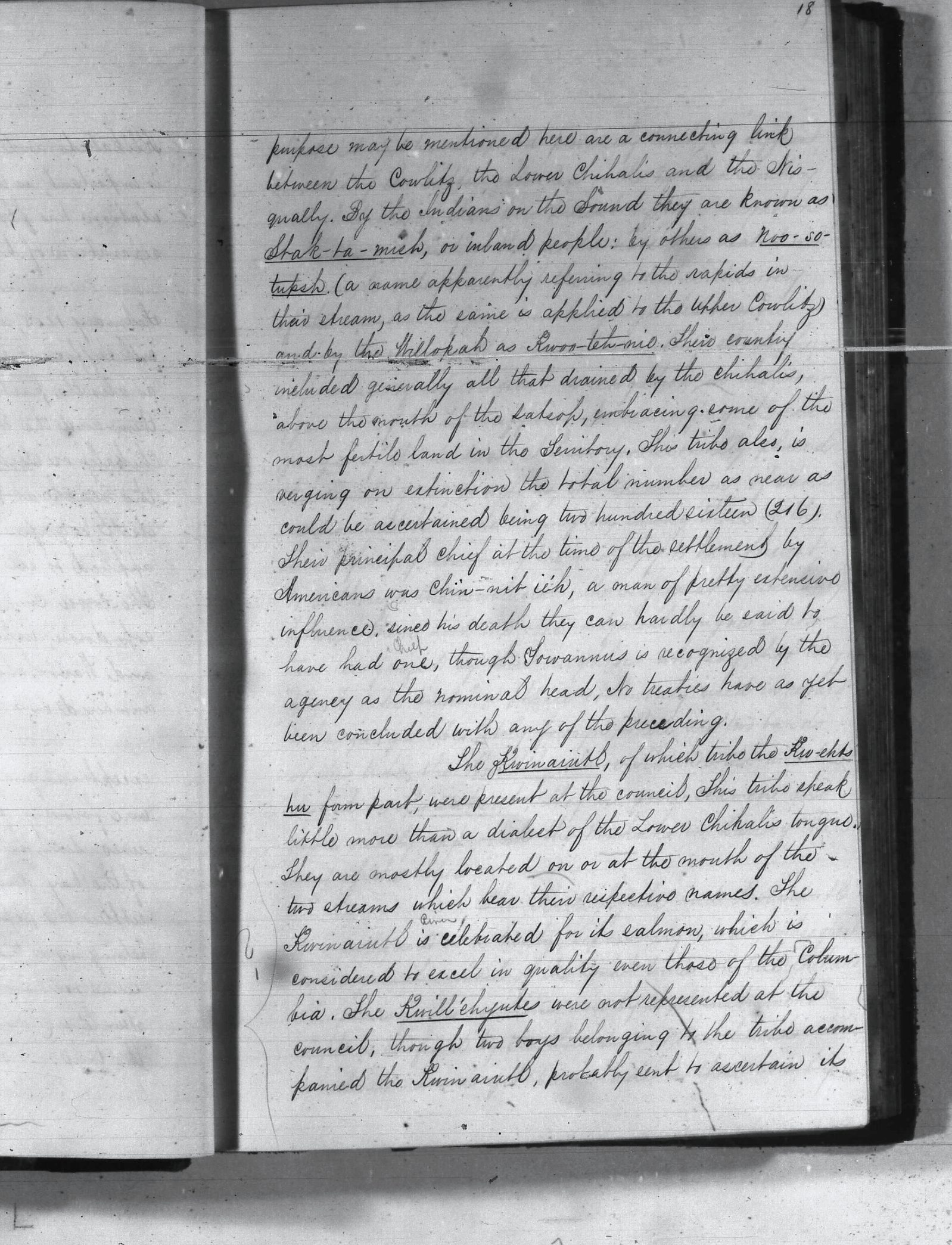
Preserved transcription
Transcription matched to this Wisconsin microfilm frame. Preserved from the supplied frame transcription; compare uncertain readings with the scan.
[page number, top right:] 18
purpose may be mentioned here are a connecting link
between the Cowlitz, the Lower Chihalis and the Nis-
qually. By the Indians on the Sound they are known as
Stak-ta-mish, or inland people: by others as Noo-so-
tupsh (a name apparently referring to the rapids in
their stream, as the same is applied to the Upper Cowlitz)
and by the Willopah as Kwoo-teh-mie[?]. Their country
included generally all that drained by the chihalis,
above the mouth of the Satsop, embracing some of the
most fertile land in the Territory. This tribe also, is
verging on extinction the total number as near as
could be ascertained being two hundred sixteen (216).
Their principal chief at the time of the settlement by
Americans was Chin-nit ich, a man of pretty extensive
influence. since his death they can hardly be said to
have had one [inserted: chief], though Towannus[?] is recognized by the
agency as the nominal head. No treaties have as yet
been concluded with any of the preceding.
The Kwinaiutl, of which tribe the Kw-ehts-
hu form part, were present at the council. This tribe speak
little more than a dialect of the Lower Chihalis tongue.
They are mostly located on or at the mouth of the
two streams which bear their respective names. The
Kwinaiutl [inserted: River] is celebrated for its salmon, which is
considered to excel in quality even those of the Colum-
bia. The Kwill'ehyutes were not represented at the
council, though two boys belonging to the tribe accom-
panied the Kwinaiutl, probably sent to ascertain its
Wisconsin Historical Society · WHS-R2-1653 · George Gibbs IV ethnographic ms., notebook p.13 (document), c.1856
Open the complete archive frame record →