
Read the original · Check the transcription
Gibbs Family Papers, Reel 2, frame 1648
Preserved transcription
Transcription matched to this Wisconsin microfilm frame. Preserved from the supplied frame transcription; compare uncertain readings with the scan.
[page number, top right:] 13
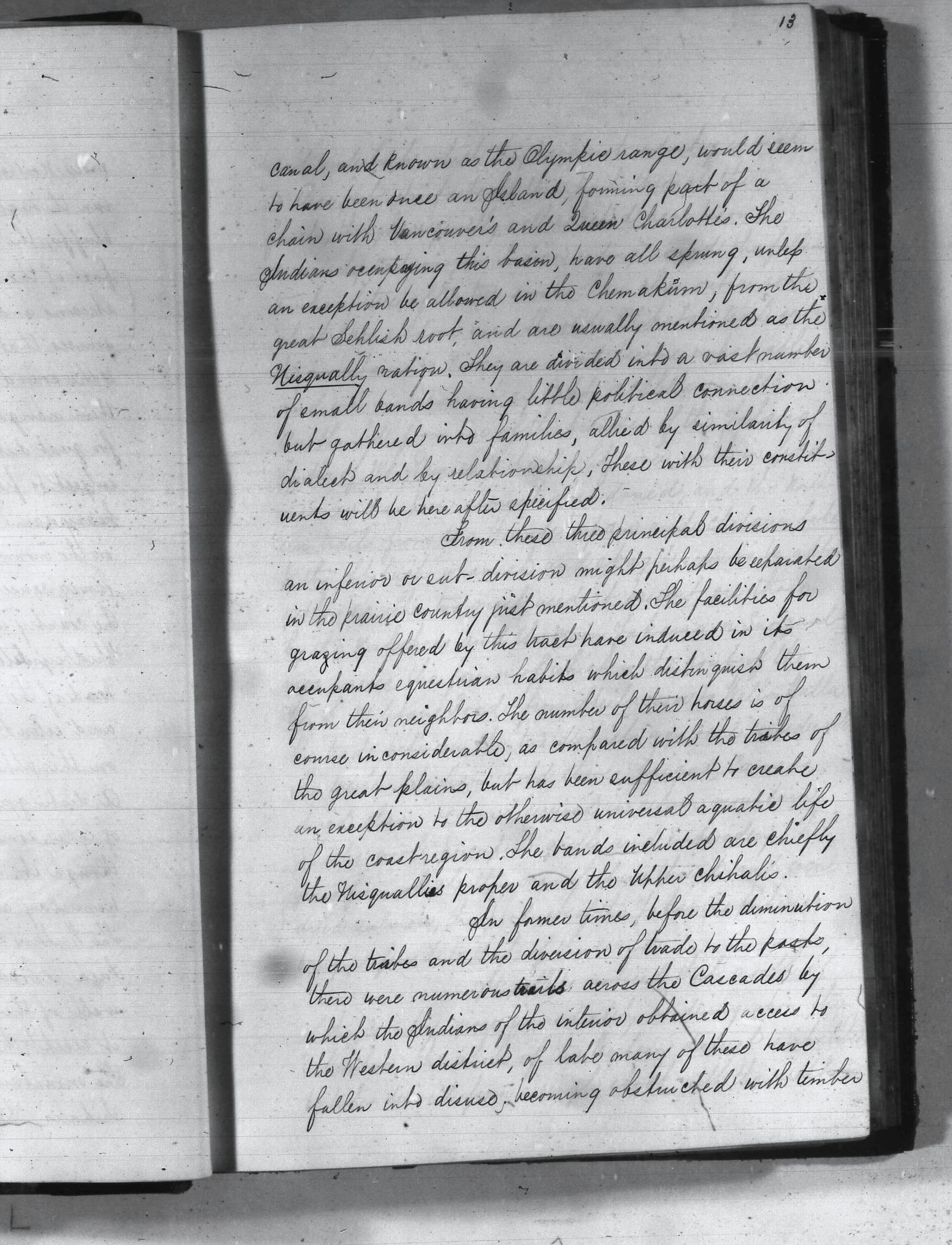
canal, and known as the Olympic range, would seem
to have been once an Island, forming part of a
chain with Vancouver's and Queen Charlotte's. The
Indians occupying this basin, have all sprung, unless
an exception be allowed in the Chemakŭm, from the
great Selish[?] root, and are usually mentioned as the
Nisqually nation. They are divided into a vast number
of small bands having little political connection
but gathered into families, allied by similarity of
dialect and by relationship. These with their constit-
uents will be hereafter specified.
From these three principal divisions
an inferior or sub-division might perhaps be separated
in the prairie country just mentioned. The facilities for
grazing offered by this tract have induced in its
occupants equestrian habits which distinguish them
from their neighbors. The number of their horses is of
course inconsiderable, as compared with the tribes of
the great plains, but has been sufficient to create
an exception to the otherwise universal aquatic life
of the coast region. The bands included are chiefly
the Nisquallies proper and the Upper chihalis.
In former times, before the diminution
of the tribes and the diversion[?] of trade to the posts,
there were numerous trails across the Cascades by
which the Indians of the interior obtained access to
the Western district, of late many of these have
fallen into disuse, becoming obstructed with timber
Wisconsin Historical Society · WHS-R2-1648 · George Gibbs IV ethnographic ms., notebook p.13 (document), c.1856
Open the complete archive frame record →