
Read the original · Check the transcription
Gibbs Family Papers, Reel 2, frame 1606
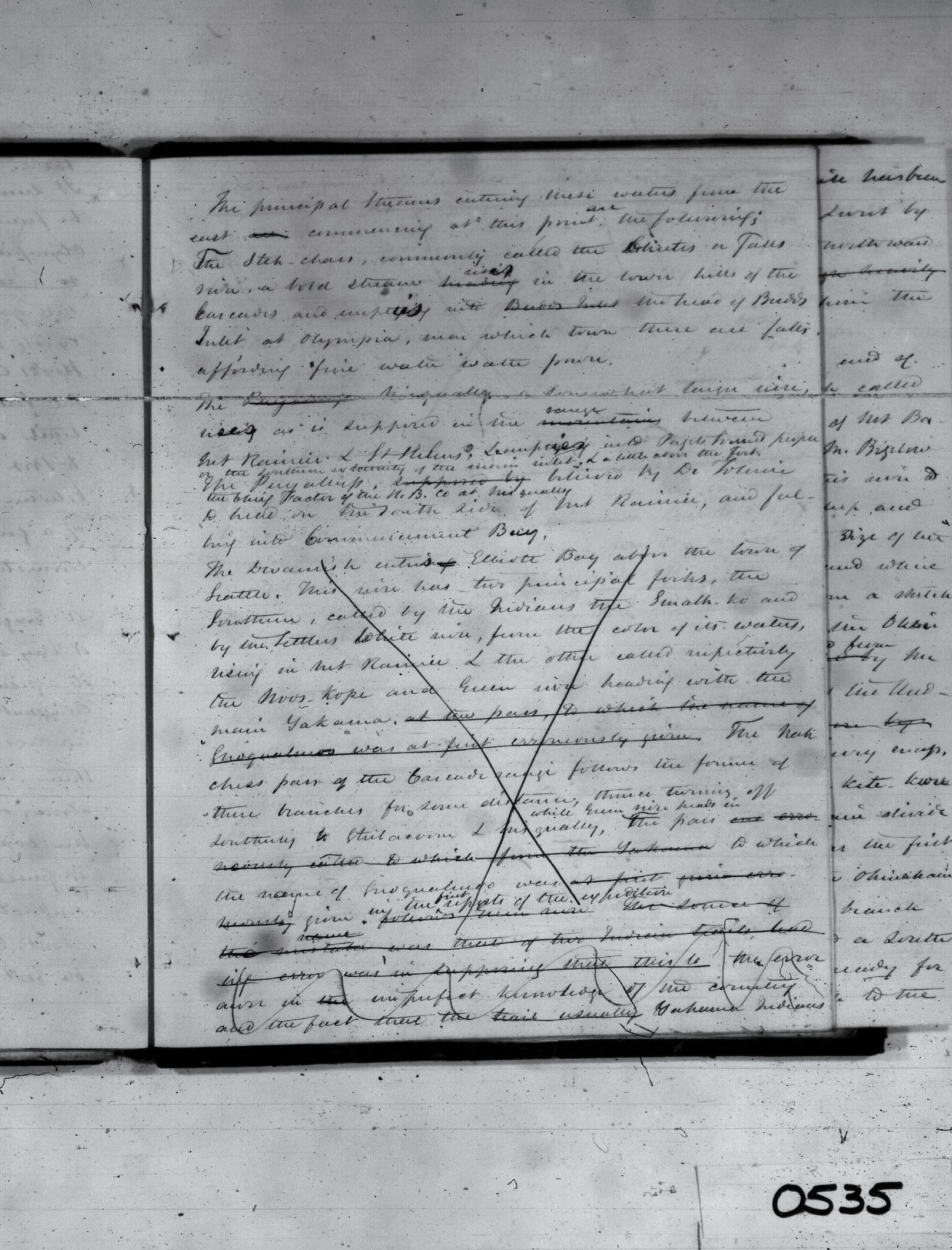
Preserved transcription
Transcription matched to this Wisconsin microfilm frame. Preserved from the supplied frame transcription; compare uncertain readings with the scan.
The principal streams entering these waters from the
east [struck: are] commencing at this point [inserted: are] the following;
The Steh-chass, commonly called the Deschutes or Falls
river, a bold stream [struck: heading] [inserted: rising] in the lower hills of the
Cascades and empties into [struck: Budds Inlet] the head of Budds
Inlet at Olympia, near which town there are falls
affording fine water water power.
The [struck: Puyallup] Nisqually a somewhat large river,
rises as is supposed in the [struck: mountains] [inserted: range] between
Mt Rainier & St Helens, & empties into Puget Sound proper
[inserted: or the southern extremity of the main inlet, & a little above the Fort.]
The Puyallup [struck: supposed by] believed by Dr Tolmie
[inserted: the chief Factor of the H. B. Co at Nisqually]
to head on the south side of Mt Rainier, and fal-[?]
ling[?] into Commencement Bay.
The Dwamish enters Elliott Bay above the town of
Seattle. This river has two principal forks, the
Southern, called by the Indians the Smalh-ko[?] and
by the settlers White river, from the color of its waters,
rising in Mt Rainier & the other called respectively
the Noos-kope and Green river heading with the
main Yakama [struck: at the pass, to which the name of
Snoqualmoo was at first erroneously given.] The Nah-
chess pass of the Cascade range follows the former of
these branches for some distance, thence turning off
southerly to Steilacoom & Nisqually, [inserted: while Green river heads in] the pass [struck: no] [struck: erro]
[struck: recently called to which from the Yakama] to which
the name of Snoqualmoo was [struck: at first given err-
oneously] given [inserted: in the first reports of the expedition] [struck: follows Green river] [struck: The source of
the mistake] [inserted: [struck: name]] [struck: was that of two Indian trails, the
& the error was in supposing that this to] the error
arose in [struck: the] imperfect knowledge of the country
and the fact that [struck: the trail usually] Yakama Indians
Wisconsin Historical Society · WHS-R2-1606 · Draft report page, George Gibbs (document), n.d. (c.1854)
Open the complete archive frame record →