
Read the original · Check the transcription
Gibbs Family Papers, Reel 3, frame 37 (reading copy)
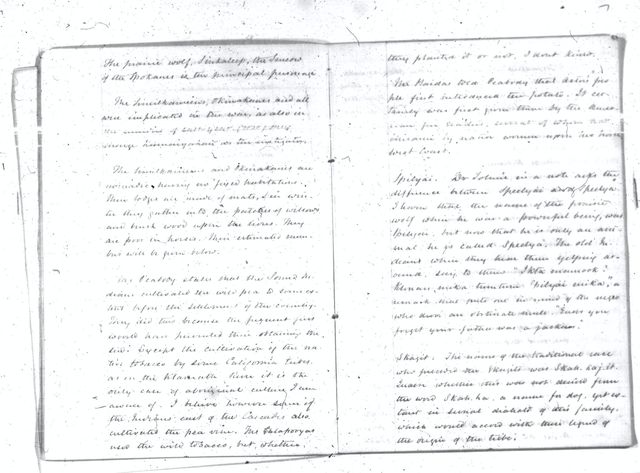
Preserved transcription
Transcription matched to this Wisconsin microfilm frame. Preserved from the supplied frame transcription; compare uncertain readings with the scan.
The prairie wolf, Sinkaleep[?], the Smeow[?]
of the Spokanes is the principal personage[?]
The Similkameens, Okinakanes and all
were implicated in the war, as also in
the murders of last year (1858[?]) they
charge Kamaiyakan[?] as the instigator.
The Similkameens and Okinakanes are
nomadic, having no fixed habitations.
Their lodges are made of mats, & in win-
ter they gather into the patches of willows
and brush wood upon the rivers. They
are poor in horses. Their estimated num-
bers will be given below.
Mr Peabody states that the Sound In-
dians cultivated the wild pea to some ex-
tent before the settlement of the country.
They did this because the frequent fires
would have prevented their obtaining the
seed. Except the cultivation of the na-
tive tobacco by some California tribes,
as on the Klamath River it is the
only case of aboriginal culture I am
aware of. I believe however some of
the Indians east of the Cascades also
cultivated the pea vine. The Calapooyas
used the wild tobacco, but, whether
they planted it or not, I dont know.
The Haidas told Peabody that Astors peo-
ple first introduced the potato. It cer-
tainly was first given them by the Amer-
ican fur traders, several of whom had
children by native women upon the north
west Coast.
Spilyai. Dr Tolmie in a note asks the
difference between Speelyai and Speelya.
I know that the name of the prairie
wolf when he was a powerful being, was
Spilyai, but now that he is only an ani-
mal he is called Speelya. The old In-
dians when they hear them yelping ar-
ound, say to them "Ikta mamook?
Klunas[?] mika[?] tumtum Spilyai mika", a
remark that puts me in mind of the negro
who drove an obstinate mule. "Guess you
forgot your father was a jackass."
Skagit. The name of the traditional race
who preceded the Skagits was Skah-kaj-it.
Quaere whether this was not derived from
the word Skah-ha, a name for dog, yet ex-
tant in several dialects of this family,
which would accord with their legend of
the origin of the tribe.
Wisconsin Historical Society · WHS-R3-37 · George Gibbs IV (field notebook) (document)
Open the complete archive frame record →