
Read the original · Check the transcription
Gibbs Family Papers, Reel 3, frame 36 (reading copy)
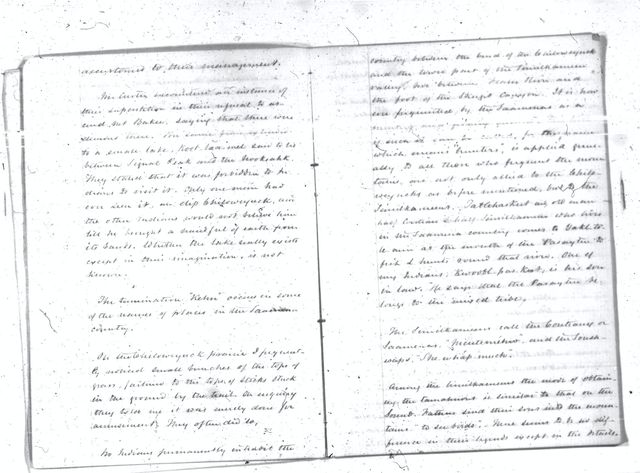
Preserved transcription
Transcription matched to this Wisconsin microfilm frame. Preserved from the supplied frame transcription; compare uncertain readings with the scan.
accustomed to their management[?].
Mr Curtis mentioned an instance of
their superstition in their refusal to as-
cend Mt Baker, saying that there were
demons there. The same fear extended
to a small lake, Koot-laa-mel said to lie
between Signal Peak and the Nooksahk.
They stated that it was forbidden to In-
dians to visit it. Only one man had
ever seen it, an old[?] Chiloweyuck, and
the other Indians would not believe him
till he brought a handful of earth from
its banks. Whether the lake really exists
except in their imagination, is not
known.
The termination "Kehn" occurs in some
of the names of places in the Saamena[?]
country.
On the Chiloweyuck prairie I frequent-
ly noticed small bunches of the tops of
grass, fastened to the tops of sticks stuck
in the ground by the trail. On enquiry
they told me it was merely done for
amusement. They often did so.
No Indians permanently inhabit the
country between the bend of the Chiloweyuck
and the lower part of the Similkameen
valley, nor between Fraser River and
the foot of the Skagit Canyon. It is how-
ever frequented by the Saamenas as a
hunting[?] and fishing[?] ground. The tribe[?]
if such it can be called, for the name
which means "hunters", is applied gener-
ally to all those who frequent the moun-
tains, are not only allied to the Chilo-
weyucks as before mentioned, but to the
Similkameens. Tatlehasket an old man
half Coutani & half Similkameen who lives
in the Saamena country comes to Yakl-to-
le-min at the mouth of the Pasaytin to
fish & hunts round that river. One of
my Indians, Kwootl-pas-kut, is his son
in law. He says that the Pasaytin be-
longs to the mixed tribe.
The Similkameens call the Coutanies or
Saamenas, "Zicutemchio[?]", and the Soush-
waps, "She-whap-much".
Among the Similkameens the mode of obtain-
ing the tamanous is similar to that on the
Sound. Fathers send their sons into the moun-
tains "to see birds". There seems to be no dif-
ference in their legends except in the details.
Wisconsin Historical Society · WHS-R3-36 · George Gibbs IV (field notebook) (document)
Open the complete archive frame record →