
Read the original · Check the transcription
Gibbs Family Papers, Reel 3, frame 32 (reading copy)
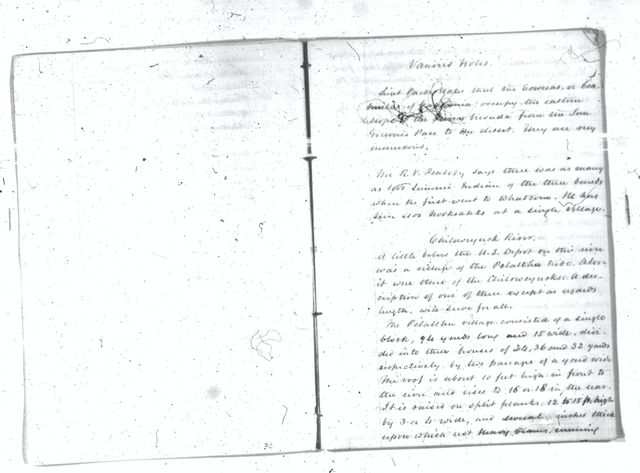
Preserved transcription
Transcription matched to this Wisconsin microfilm frame. Preserved from the supplied frame transcription; compare uncertain readings with the scan.
Various Notes.
Lieut Parke states[?] that the Cowicas[?], or Coa-
huilas of California occupy the eastern
slope of the Sierra Nevada from the San
Gorgonio Pass. to the desert. They are very
numerous.
Mr R. V. Peabody says there was as many
as 1000[?] Lummi Indians of the three bands
when he first went to Whatcom. He has
seen 400[?] Nooksahks[?] at a single village.
Chiloweyuck River.
A little below the U.S. Depot on this river
was a village of the Pelalthu tribe. Above
it were those of the Chiloweyucks. A des-
cription of one of these except as regards
length, will serve for all.
The Pelalthu village consisted of a single
block, 94 yards long and 15 wide, divi-
ded into three houses of 24, 36 and 32 yards
respectively, by two passages of a yard wide
The roof is about 10 feet high in front to
the river and rises to 16 or 18 in the rear.
It is raised on split planks, 12 to 15 ft. high
by 3 or 4 wide, and several inches thick
upon which rest heavy beams, running
Wisconsin Historical Society · WHS-R3-32 · George Gibbs IV (field notebook) (document)
Open the complete archive frame record →