
Read the original · Check the transcription
Gibbs Family Papers, Reel 2, frame 1563
Preserved transcription
Transcription matched to this Wisconsin microfilm frame. Preserved from the supplied frame transcription; compare uncertain readings with the scan.
31
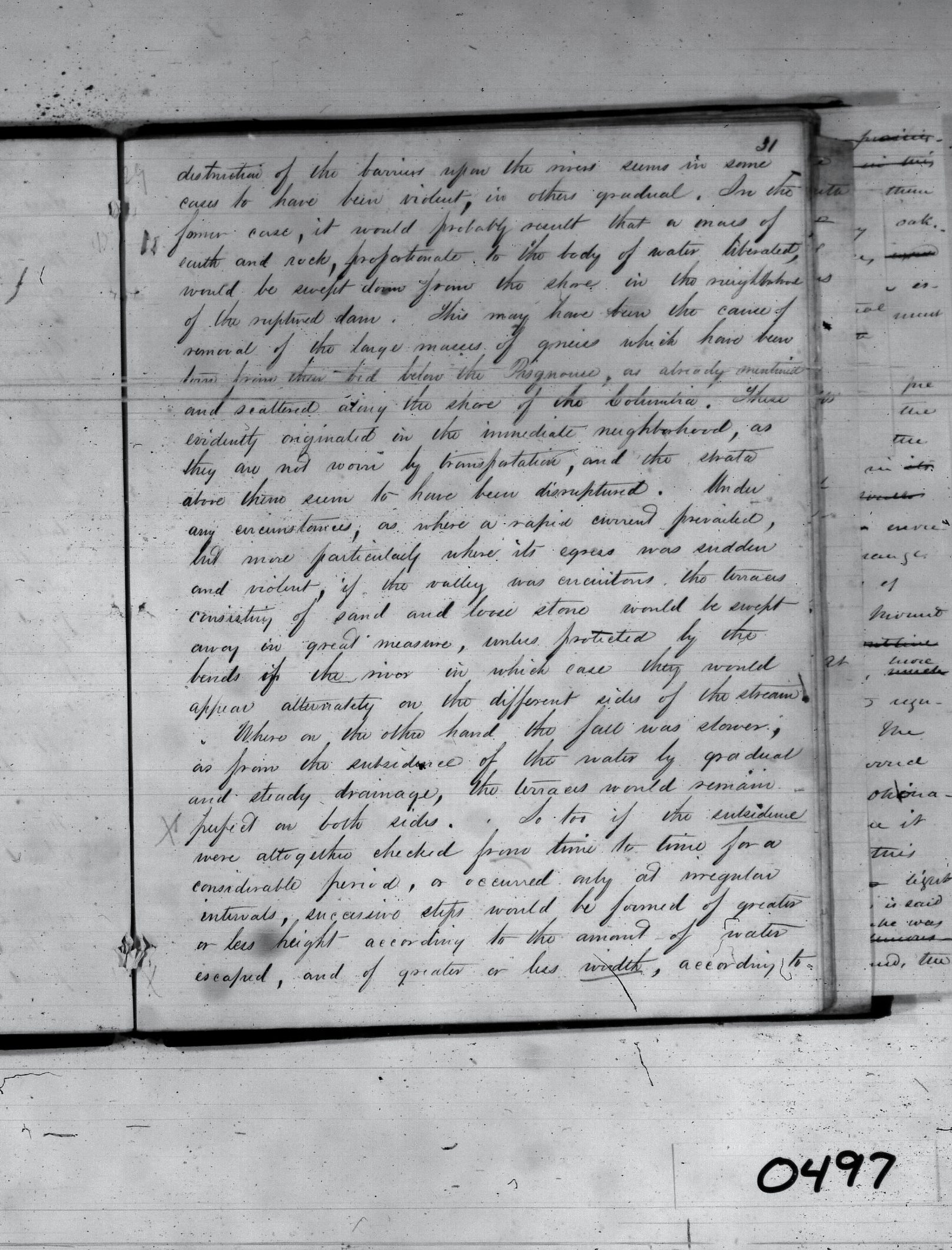
destruction of the barriers upon the rivers seems in some
cases to have been violent, in others gradual. In the
former case, it would probably result that a mass of
earth and rock, proportionate to the body of water liberated,
would be swept down from the shore in the neighbhood[?]
of the ruptured dam. This may have been the cause of
removal of the large masses of gneiss which have been
torn from their bed below the Pisquouse[?], as already mentioned
and scattered along the shore of the Columbia. These
evidently originated in the immediate neighborhood, as
they are not worn by transportation, and the strata
above them seem to have been disrupted. Under
any circumstances, as where a rapid current prevailed,
but more particularly where its egress was sudden
and violent, if the valley was circuitous, the terraces
consisting of sand and loose stone would be swept
away in great measure, unless protected by the
bends of the river in which case they would
appear alternately on the different sides of the stream.
Where on the other hand the fall was slower,
as from the subsidence of the water by gradual
and steady drainage, the terraces would remain
perfect on both sides. So too if the subsidence
were altogether checked from time to time for a
considerable period, or occurred only at irregular
intervals, successive steps would be formed of greater
or less height according to the amount of water
escaped, and of greater or less width, according to
Wisconsin Historical Society · WHS-R2-1563 · George Gibbs draft report (geology, upper Columbia) (document), n.d. [c.1853-54]
Open the complete archive frame record →