
Read the original · Check the transcription
Gibbs Family Papers, Reel 2, frame 1560
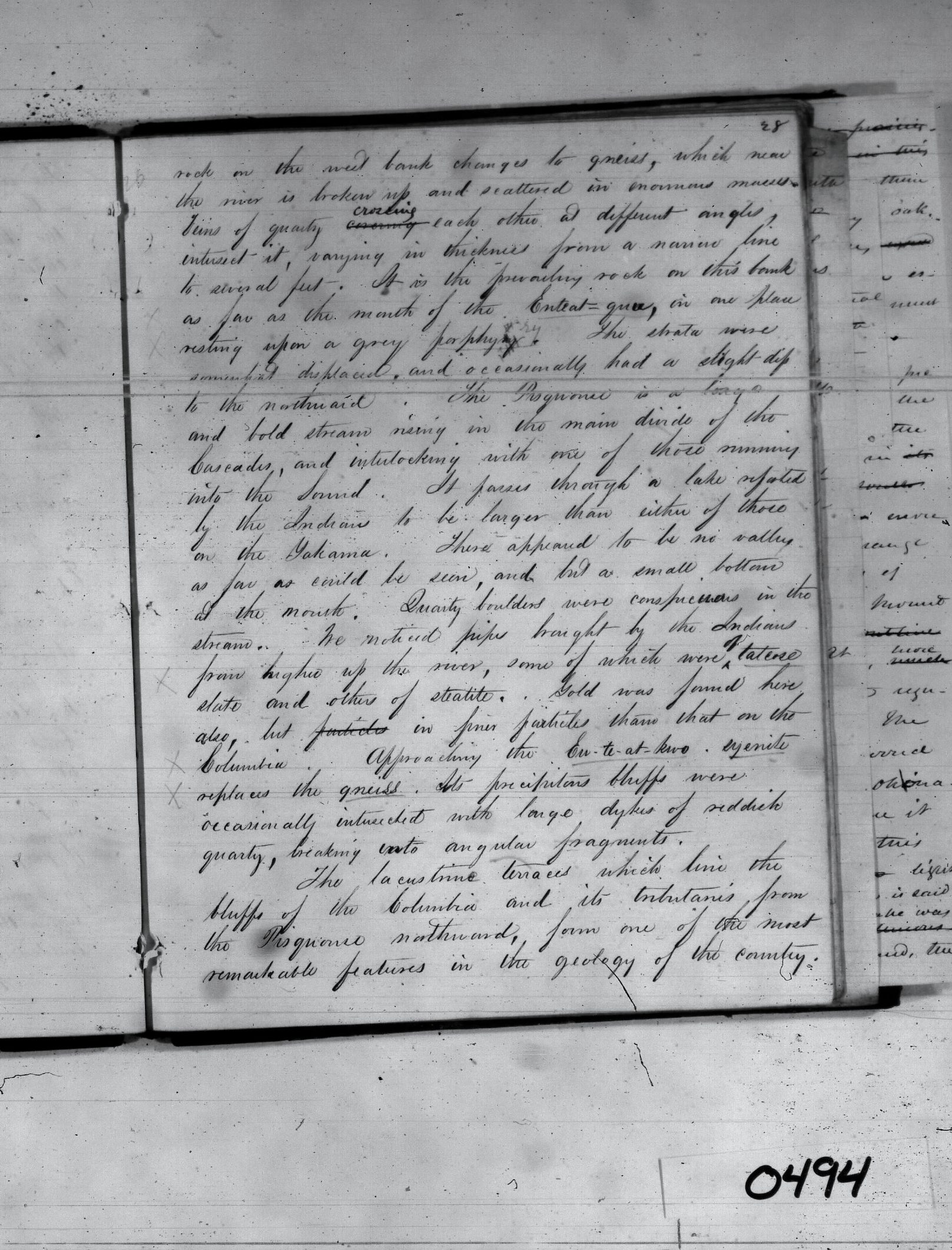
Preserved transcription
Transcription matched to this Wisconsin microfilm frame. Preserved from the supplied frame transcription; compare uncertain readings with the scan.
[page number, top right:] 28
rock in the west bank changes to gneiss, which near
the river is broken up and scattered in enormous masses.
Veins of quartz [inserted: crossing] [struck: covering] each other at different angles,
intersect it, varying in thickness from a narrow line
to several feet. It is the prevailing rock on this bank
as far as the mouth of the Enteat=qua, in one place
resting upon a grey porphyry[?] [inserted: ?Sy[?]]. The strata were
somewhat displaced, and occasionally had a slight dip
to the northward. The Pisquouse is a large
and bold stream rising in the main divide of the
Cascades, and interlocking with one of those running
into the Sound. It passes through a lake reported
by the Indians to be larger than either of those
on the Yakama. There appeared to be no valley
as far as could be seen, and but a small bottom
at the mouth. Quartz boulders were conspicuous in the
stream. We noticed pipes brought by the Indians
from higher up the river, some of which were [inserted: of] talcose
slate and others of steatite. Gold was found here
also, but [struck: particles] in finer particles than that on the
Columbia. Approaching the En-te-at-kwo. syenite
replaces the gneiss. Its precipitous bluffs were
occasionally intersected with large dykes of reddish
quartz, breaking into angular fragments.
The lacustrine terraces which line the
bluffs of the Columbia and its tributaries from
the Pisquouse northward, form one of the most
remarkable features in the geology of the country.
[stamp: 0494]
Wisconsin Historical Society · WHS-R2-1560 · George Gibbs draft report (geology, upper Columbia) (document), n.d. [c.1853-54]
Open the complete archive frame record →