
Read the original · Check the transcription
Gibbs Family Papers, Reel 3, frame 25 (reading copy)
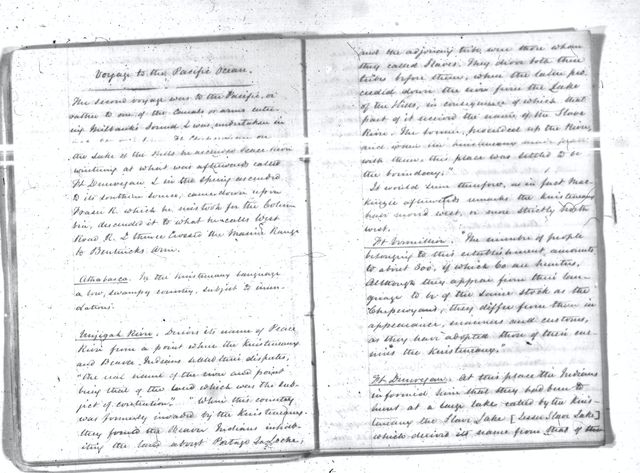
Preserved transcription
Transcription matched to this Wisconsin microfilm frame. Preserved from the supplied frame transcription; compare uncertain readings with the scan.
Voyage to the Pacific Ocean.
The second voyage was to the Pacific, or
rather to one of the Canals or arms enter-
ing Milbank's Sound & was undertaken in
[illegible] Starting[?] from Ft Chepewyan[?] on
the Lake of the Hills he ascended Peace River
wintering at what was afterwards called
Ft Dunvegan & in the spring ascended
to its southern source, came down upon
Fraser R. which he mistook for the Colum
bia, descended it to what he calls West
Road R. & thence crossed the Marine[?] Range
to Bentincks Arm.
Athabasca. In the Knistenaux language
a low, swampy country, subject to inun-
dations.
Unjigah River. Derives its name of Peace
River from a point where the Knistenaux
and Beaver Indians settled their disputes,
"the real name of the river and point
being that of the land which was the sub-
ject of contention". "When this country
was formerly invaded by the Knistenaux
they found the Beaver Indians inhab-
iting the land about Portage La Loche;
and the adjoining tribe were those whom
they called Slaves. They drove both these
tribes before them; when the latter pro-
ceeded down the river from the Lake
of the Hills, in consequence of which that
part of it received the name of the Slave
River. The former, proceeded up the River,
and when the Knistenaux made peace
with them, this place was settled to be
the boundary."
It would seem therefore, as in fact Mac-
Kenzie afterwards remarks the Knistenaux
have moved west, or more strictly north
west.
Ft Vermillion. "The number of people
belonging to this establishment, amounts
to about 300, of which 60 are hunters.
Although they appear from their lan-
guage to be of the same stock as the
Chepewyans, they differ from them in
appearance, manners and customs,
as they have adopted those of their ene-
mies the Knistenaux."
Ft Dunvegan. At this place the Indians
informed him that they had been to
hunt at a large lake called by the Knis-
tenaux the Slave Lake [Lesser Slave Lake]
which derived its name from that of the
Wisconsin Historical Society · WHS-R3-25 · Letter from George Gibbs (reading notes) to notebook
Open the complete archive frame record →