
Read the original · Check the transcription
Gibbs Family Papers, Reel 3, frame 24 (reading copy)
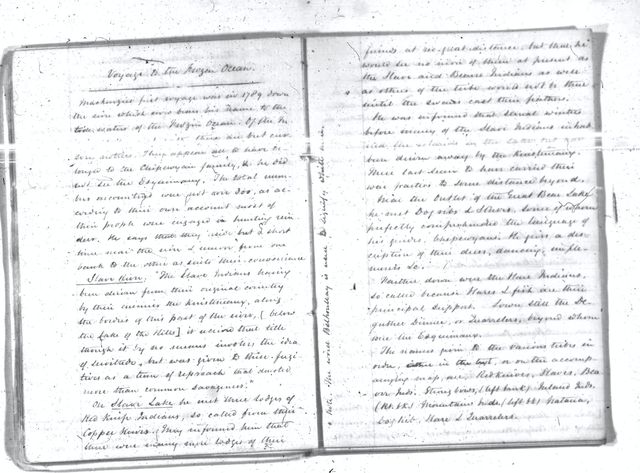
Preserved transcription
Transcription matched to this Wisconsin microfilm frame. Preserved from the supplied frame transcription; compare uncertain readings with the scan.
Voyage to the Frozen Ocean.
Mackenzie's first voyage was in 1789 down
the river which now bears his name to the
tide waters of the Frozen Ocean. Of the In-
[illegible, ~3 words] there are but cur-
sory notices. They appear all to have be-
longed to the Chipewyan family, & he did
not see the Esquimaux. The total num-
bers encountered were not over 300, as ac-
cording to their own account most of
their people were engaged in hunting rein-
deer. He says that they reside but a short
time near the river & remove from one
bank to the other as suits their convenience
Slave Riv. "The Slave Indians having
been driven from their original country
by their enemies the Knistineaux, along
the borders of this part of the river, [below
the Lake of the Hills] it arose that title
though it by no means involves the idea
of servitude, but was given to these fugi-
tives as a term of reproach that denoted
more than common savageness."
On Slave Lake he met three lodges of
Red Knife Indians, so called from their
Copper Knives. They informed him that
there were many more lodges of their
[right-hand page]
friends at no great distance, but that he
would see no more of them at present as
the Slave and Beaver Indians as well
* as others of the tribe would not be there
until the swans cast their feathers.
He was informed that several winters
before many of the Slave Indians inhab-
ited the islands in the Lake but had
been driven away by the Knistineaux.
These last seem to have carried their
war parties to some distance beyond.
Near the Outlet of the Great Bear Lake
he met Dog ribs & Slaves, some of whom
perfectly comprehended the language of
his guides, Chipewyans. He gives a des-
cription of their dress, dancing, imple-
ments &c.
Farther down were the Hare Indians,
so called because Hares & fish are their
principal support. Lower still the De-
guthee Dinnee, or Quarrelers, beyond whom
were the Esquimaux.
The names given to the various tribes in
order, [struck: either] in the text, or on the accomp-
anying map, are: Red Knives, Slaves, Bea-
ver Inds. Strong bows, (left bank) Inland Inds.
(Rt. bk.) Mountain Inds. (left bk) Natana[?],
Dog Rib, Hare & Quarrelers.
[written vertically in the gutter margin]
* Note. The word Bethoullay[?] is used to signify white man.
Wisconsin Historical Society · WHS-R3-24 · Letter from George Gibbs (reading notes) to notebook
Open the complete archive frame record →