
Read the original · Check the transcription
Gibbs Family Papers, Reel 3, frame 238 (reading copy)
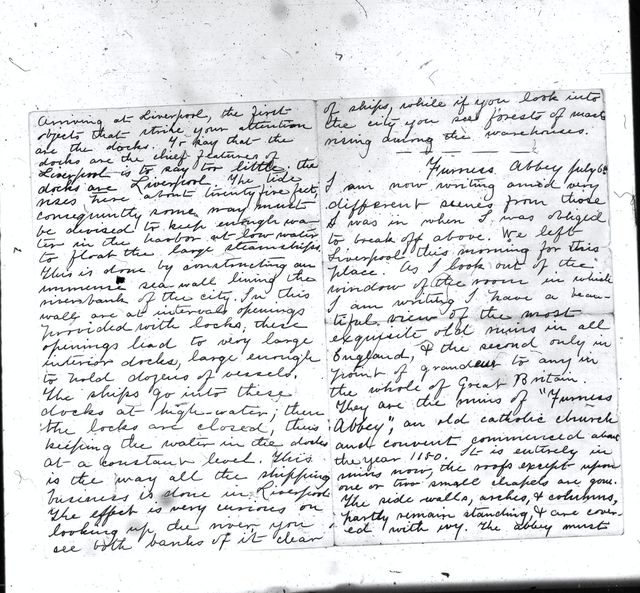
Preserved transcription
Transcription matched to this Wisconsin microfilm frame. Preserved from the supplied frame transcription; compare uncertain readings with the scan.
Arriving at Liverpool, the first
objects that strike your attention
are the docks. To say that the
docks are the chief features of
Liverpool is to say too little; the
docks are Liverpool. The tide
rises here about twenty five feet;
consequently some way must
be devised to keep enough wa-
ter in the harbor at low water
to float the large steamships.
This is done by constructing an
immense sea-wall lining the
riverbank of the city. In this
wall are at intervals openings
provided with locks; these
openings lead to very large
interior docks, large enough
to hold dozens of vessels.
The ships go into these
docks at high-water; then
the locks are closed, thus
keeping the water in the docks
at a constant level. This
is the way all the shipping
business is done in Liverpool.
The effect is very curious on
looking up the river; you
see both banks of it clear
of ships, while if you look into
the city you see forests of masts
rising among[?] the warehouses.
— — — — —
Furness Abbey July 6th
I am now writing amid very
different scenes from those
I was in when I was obliged
to break off above. We left
Liverpool this morning for this
place. As I look out of the
window of the room in which
I am writing I have a beau-
tiful view of the most
exquisite old ruins in all
England, & the second only in
point of grandeur to any in
the whole of Great Britain.
They are the ruins of "Furness
Abbey", an old catholic church
and convent commenced about
the year 1150. It is entirely in
ruins now, the roofs except upon
one or two small chapels are gone.
The side walls, arches, & columns,
partly remain standing, & are cover-
ed with ivy. The abbey must
Wisconsin Historical Society · WHS-R3-238 · Letter from George Gibbs V to "My Dear Mother", 1880-07-05
Open the complete archive frame record →