
Read the original · Check the transcription
Gibbs Family Papers, Reel 3, frame 22 (reading copy)
Preserved transcription
Transcription matched to this Wisconsin microfilm frame. Preserved from the supplied frame transcription; compare uncertain readings with the scan.
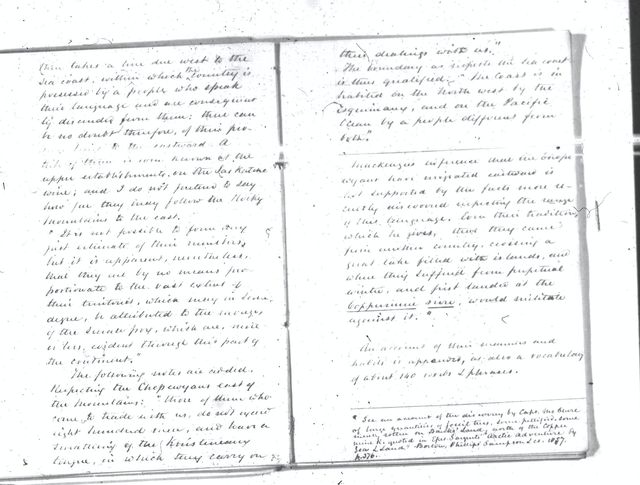
then takes a line due west to the
sea coast, within which [inserted: the] country is
possessed by a people who speak
their language and are consequent-
ly descended from them: there can
be no doubt therefore, of their pro-
gress[?] being[?] to the eastward. A
tribe of them is even known at the
upper establishments on the Saskatche-
wine; and I do not pretend to say
how far they may follow the Rocky
Mountains to the east.
"It is not possible to form any
just estimate of their numbers,
but it is apparent, nevertheless,
that they are by no means pro-
portionate to the vast extent of
their territories, which may in some
degree, be attributed to the ravages
of the small pox, which are, more
or less, evident through this part of
the continent."
The following notes are added.
Respecting the Chepewyans east of
the mountains: "those of them who
come to trade with us, do not exceed
eight hundred men, and have a
smattering of the Knisteneaux
tongue, in which they carry on
their dealings with us."
The boundary as respects the sea coast
is thus qualified: "The coast is in-
habited on the North west by the
Esquimaux[?], and on the Pacific
Ocean by a people different from
both."
Mackenzie's inference that the Chepe-
wyans have migrated eastward is
best supported by the facts more re-
cently discovered respecting the range
of this language. Even their tradition,
which he gives, that they came
from another country, crossing a
great lake filled with islands, and
where they suffered from perpetual
winter, and first landed at the
Coppermine river, would militate
against it. *
An account of their manners and
habits is appended, as also a vocabulary
of about 140 words & phrases.
* See an account of the discovery by Capt. Mc Clure
of large quantities of fossil trees, some petrified, some
merely rotten on Banks' Land, north of the Copper
mine R. quoted in Epes Sargent's "Arctic Adventure by
Sea & Land." Boston, Phillips Sampson & Co. 1857.
p. 376.
Wisconsin Historical Society · WHS-R3-22 · Letter from George Gibbs (reading notes) to notebook
Open the complete archive frame record →