
Read the original · Check the transcription
Gibbs Family Papers, Reel 3, frame 647 (thumbnail)
Preserved transcription
Transcription matched to this Wisconsin microfilm frame. Preserved from the supplied frame transcription; compare uncertain readings with the scan.
100.
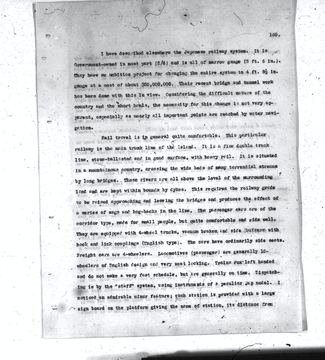
I have described elsewhere the Japanese railway system. It is
Government-owned in most part (5/6) and is all of narrow gauge (3 ft. 6 in.).
They have an ambition project for changing the entire system to 4 ft. 8½ in.
gauge at a cost of about $50,000,000. Their recent bridge and tunnel work
has been done with this in view. Considering the difficult nature of the
country and the short hauls, the necessity for this change is not very ap-
parent, especially as nearly all important points are reached by water navi-
gation.
Rail travel is in general quite comfortable. This particular
railway is the main trunk line of the Island. It is a fine double track
line, stone-ballasted and in good surface, with heavy rail. It is situated
in a mountainous country, crossing the wide beds of many torrential streams
by long bridges. These rivers are all above the level of the surrounding
land and are kept within bounds by dykes. This requires the railway grade
to be raised approaching and leaving the bridges and produces the effect of
a series of sags and hog-backs in the line. The passenger cars are of the
corridor type, made for small people, but quite comfortable and ride well.
They are equipped with 4-wheel trucks, vacuum brakes and side buffers with
hook and link couplings (English type). The cars have ordinarily side seats.
Freight cars are 4-wheelers. Locomotives (passenger) are generally 10-
wheelers of English design and very neat looking. Trains run left handed
and do not make a very fast schedule, but are generally on time. Dispatch-
ing is by the "staff" system, using instruments of a peculiar Jap model. I
noticed an admirable minor feature; each station is provided with a large
sign board on the platform giving the name of station, its distance from
Wisconsin Historical Society · WHS-R3-647 · DUPLICATE microfilm exposure of frame 637 (document), (cont.)
Open the complete archive frame record →