
Read the original · Check the transcription
Gibbs Family Papers, Reel 3, frame 637 (thumbnail)
Preserved transcription
Transcription matched to this Wisconsin microfilm frame. Preserved from the supplied frame transcription; compare uncertain readings with the scan.
[printed/typed page number: 91.]
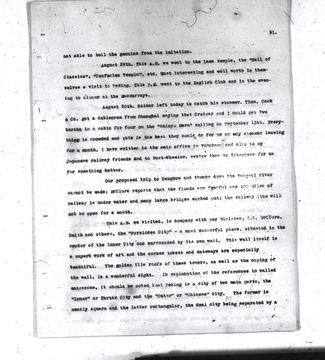
not able to tell the genuine from the imitation.
August 29th. This A.M. we went to the Lama temple, the "Hall of
Classics", "Confucian Temple", etc. Most interesting and well worth in them-
selves a visit to Peking. This P.M. went to the English Club and in the even-
ing to dinner at the MacMurrays.
August 30th. Golder left today to catch his steamer. Thos. Cook
& Co. got a cablegram from Shanghai saying that Greiner and I could get two
berths in a cabin for four on the "Shinyo Maru" sailing on September 15th. Every-
thigg is crowded and this is the best they could do for us on any steamer leaving
for a month. I have written to the main office in Yokohama and also to my
Japanese railway friends and to Post-Wheeler, asking them to intercede for us
for something better.
Our proposed trip to Hangkow and thence down the Yangsti river
cannot be made; McClure reports that the floods are fearful and 100 miles of
railway is under water and many large bridges washed out; the railway line will
not be open for a month.
This A.M. we visited, in company with our Minister, S.S. McClure,
Smith and others, the "Forbidden City" - a most wonderful place, situated in the
center of the inner City and surrounded by its own wall. This wall itself is
a superb work of art and the corner towers and dateways are especially
beautiful. The golden tile roofs of these towers, as well as the coping of
the wall, is a wonderful sight. In explanation of the references to walled
entrances, it should be noted that Peking is a city of two main parts, the
"Inner" or Tartar City and the "Outer" or "Chinese" City. The former is
nearly square and the latter rectangular, the dual city being separated by a
Wisconsin Historical Society · WHS-R3-637 · Letter from George Gibbs V to journal typescript, (cont.)
Open the complete archive frame record →