
Read the original · Check the transcription
Gibbs Family Papers, Reel 3, frame 631 (thumbnail)
Preserved transcription
Transcription matched to this Wisconsin microfilm frame. Preserved from the supplied frame transcription; compare uncertain readings with the scan.
85[?].
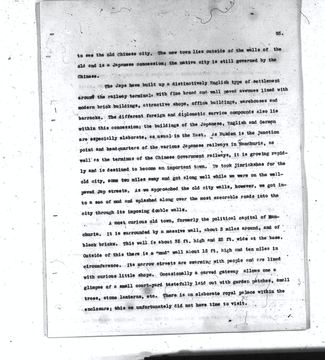
to see the old Chinese city. The new town lies outside of the walls of the
old and is a Japanese concession; the native city is still governed by the
Chinese.
The Japs have built up a distinctively English type of settlement
around the railway terminal. with fine broad and well paved avenues lined with
modern brick buildings, attractive shops, office buildings, warehouses and
barracks. The different foreign and diplomatic service compounds also lie
within this concession; the buildings of the Japanese, English and German
are especially elaborate, as usual in the East. As Mukden is the junction
point and headquarters of the various Japanese railways in Manchuria, as
well as the terminus of the Chinese Government railways, it is growing rapid-
ly and is destined to become an important town. We took jinrickshas for the
old city, some two miles away and got along well while we were on the well-
paved Jap streets. As we approached the old city walls, however, we got in-
to a sea of mud and splashed along over the most execrable roads into the
city through its imposing double walls.
A most curious old town, formerly the political capital of Man-
churia. It is surrounded by a massive wall, about 3 miles around, and of
black bricks. This wall is about 35 ft. high and 25 ft. wide at the base.
Outside of this there is a "mud" wall about 12 ft. high and ten miles in
circumference. Its narrow streets are swarming with people and are lined
with curious little shops. Occasionally a carved gateway allows one a
glimpse of a small court-yard tastefully laid out with garden patches, small
trees, stone lanterns, etc. There is an elaborate royal palace within the
enclosure; this we unfortunately did not have time to visit.
Wisconsin Historical Society · WHS-R3-631 · Letter from George Gibbs V to journal typescript, (cont.)
Open the complete archive frame record →