
Read the original · Check the transcription
Gibbs Family Papers, Reel 3, frame 558 (thumbnail)
Preserved transcription
Transcription matched to this Wisconsin microfilm frame. Preserved from the supplied frame transcription; compare uncertain readings with the scan.
20.
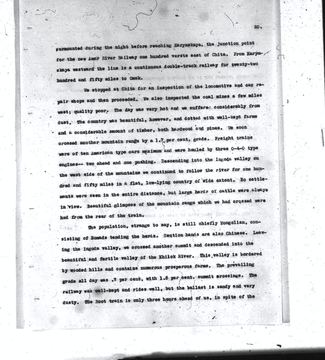
surmounted during the night before reaching Karymskaya, the junction point
for the new Amur River Railway one hundred versts east of Chita. From Karym-
skaya westward the line is a continuous double-track railway for twenty-two
hundred and fifty miles to Omsk.
We stopped at Chita for an inspection of the locomotive and car re-
pair shops and then proceeded. We also inspected the coal mines a few miles
west; quality poor. The day was very hot and we suffered considerably from
dust. The country was beautiful, however, and dotted with well-kept farms
and a considerable amount of timber, both hardwood and pines. We soon
crossed another mountain range by a 1.7 per cent. grade. Freight trains
were of ten American type cars maximum and were hauled by three 0-4-0 type
engines-- two ahead and one pushing. Descending into the Ingoda valley on
the west side of the mountains we continued to follow the river for one hun-
dred and fifty miles in a flat, low-lying country of wide extent. No settle-
ments were seen in the entire distance, but large herds of cattle were always
in view. Beautiful glimpses of the mountain range which we had crossed were
had from the rear of the train.
The population, strange to say, is still chiefly Mongolian, con-
sisting of Nomads tending the herds. Section hands are also Chinese. Leav-
ing the Ingoda valley, we crossed another summit and descended into the
beautiful and fertile valley of the Khilok River. This valley is bordered
by wooded hills and contains numerous prosperous farms. The prevailing
grade all day was .7 per cent. with 1.5 per cent. summit srossings[?]. The
railway was well-kept and rides well, but the ballast is sandy and very
dusty. The Root train is only three hours ahead of us, in spite of the
Wisconsin Historical Society · WHS-R3-558 · DUPLICATE microfilm exposure of frame 557 (document), (cont.)
Open the complete archive frame record →