
Read the original · Check the transcription
Gibbs Family Papers, Reel 3, frame 522 (thumbnail)
Preserved transcription
Transcription matched to this Wisconsin microfilm frame. Preserved from the supplied frame transcription; compare uncertain readings with the scan.
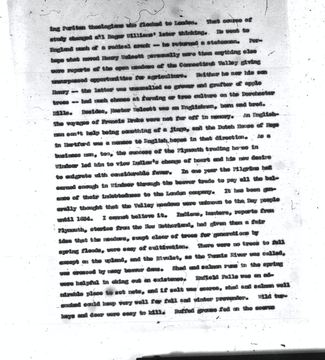
ing Puritan theologians who flocked to London. That course of
study changed all Roger Williams' later thinking. He went to
England much of a radical crank -- he returned a statesman. Per-
haps what moved Henry Wolcott personally more than anything else
were reports of the open meadows of the Connecticut Valley giving
unsurpassed opportunities for agriculture. Neither he nor his son
Henry -- the latter was unexcelled as grower and grafter of apple
trees -- had much chance at farming or tree culture on the Dorchester
Hills. Besides, Master Wolcott was an Englishman, born and bred.
The voyages of Francis Drake were not far off in memory. An English-
man can't help being something of a jingo, and the Dutch House of Hope
in Hartford was a menace to English hopes in that direction. As a
business man, too, the success of the Plymouth trading house in
Windsor led him to view Ludlow's change of heart and his new desire
to emigrate with considerable favor. In one year the Pilgrims had
earned enough in Windsor through the beaver trade to pay all the bal-
ance of their indebtedness to the London company. It has been gen-
erally thought that the Valley meadows were unknown to the Bay people
until 1634[?]. I cannot believe it. Indians, hunters, reports from
Plymouth, stories from the New Netherland, had given them a fair
idea that the meadows, swept clear of trees for generations by
spring floods, were easy of cultivation. There were no trees to fell
except on the upland, and the Rivulet, as the Tunxis[?] River was called,
was crossed by many beaver dams. Shad and salmon runs in the spring
were helpful in eking out an existence. Enfield Falls was an ad-
mirable place to set nets, and if salt was scarce, shad and salmon well
smoked could keep very well for fall and winter provender. Wild tur-
keys and deer were easy to kill. Ruffed grouse fed on the acorns
Wisconsin Historical Society · WHS-R3-522 · Letter from Mr. Shipman (Hartford) to Society of Descendants of Henry Wolcott, n.d. (enclosure)
Open the complete archive frame record →