
Read the original · Check the transcription
Gibbs Family Papers, Reel 3, frame 519 (thumbnail)
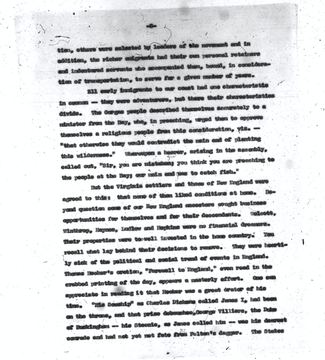
Preserved transcription
Transcription matched to this Wisconsin microfilm frame. Preserved from the supplied frame transcription; compare uncertain readings with the scan.
[printed: -5-[?]]
tion, others were selected by leaders of the movement and in
addition, the richer emigrants had their own personal retainers
and indentured servants who accompanied them, bound, in considera-
tion of transportation, to serve for a given number of years.
All early immigrants to our coast had one characteristic
in common — they were adventurers, but there their characteristics
divide. The Gorges people described themselves accurately to a
minister from the Bay, who, in preaching, urged them to approve
themselves a religious people from this consideration, viz. —
"that otherwise they would contradict the main end of planting
this wilderness." Whereupon a hearer, arising in the assembly,
called out, "Sir, you are mistaken; you think you are preaching to
the people at the Bay; our main end was to catch fish."
But the Virginia settlers and those of New England were
agreed to this: that none of them liked conditions at home. Be-
yond question some of our New England ancestors sought business
opportunities for themselves and for their descendants. Wolcott[?],
Winthrop, Haynes, Ludlow and Hopkins were no financial dreamers.
Their properties were to[inserted: o] well invested in the home country. You
recall what lay behind their decisions to remove. They were hearti-
ly sick of the political and social trend of events in England.
Thomas Hooker's oration, "Farewell to England," even read in the
crabbed printing of the day, appears a masterly effort. One can
appreciate in reading it that Hooker was a great orator of his
time. "His Sowship" as Charles Dickens called James I, had been
on the throne, and that prime debauchee,George Villiers, the Duke
of Buckingham — his Steenie, as James called him — was his dearest
comrade and had not yet met fate from Felton's dagger. The States
Wisconsin Historical Society · WHS-R3-519 · Letter from Mr. Shipman (Hartford) to Society of Descendants of Henry Wolcott, n.d. (enclosure)
Open the complete archive frame record →