
Read the original · Check the transcription
Gibbs Family Papers, Reel 3, frame 504 (thumbnail)
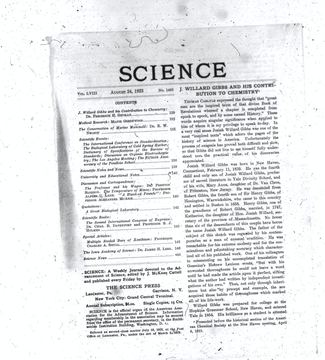
Preserved transcription
Transcription matched to this Wisconsin microfilm frame. Preserved from the supplied frame transcription; compare uncertain readings with the scan.
[printed:
SCIENCE
VOL. LVIII AUGUST 24, 1923 NO. 1495
CONTENTS
J. Willard Gibbs and his Contribution to Chemistry:
DR. FREDERICK H. GETMAN ........................ 129
Medical Research: MAJOR GREENWOOD .............. 133
The Conservation of Marine Mammals: DR. E. W.
NELSON ......................................... 135
Scientific Events:
The International Conference on Standardization;
The Biological Laboratory of Cold Spring Harbor;
Dictionary of Specifications of the Bureau of
Standards; Discussion on Organic Electrochemis-
try; The Los Angeles Meeting; The Fiftieth Anni-
versary of the Penikese School .................. 136
Scientific Notes and News ...................... 139
University and Educational Notes ............... 140
Discussion and Correspondence:
The Professor and his Wages: DR. PRESTON
SLOSSON. The Temperature of Mines: PROFESSOR
ALFRED C. LANE. "A Hundred Pounds": PRO-
FESSOR ALEXANDER MCADIE ........................ 140
Quotations:
A Great Biological Laboratory .................. 142
Scientific Books:
The Second International Congress of Eugenics:
DR. CHAS. B. DAVENPORT and PROFESSOR S. J.
HOLMES ......................................... 143
Special Articles:
Multiple Seeded Burs of Xanthium: PROFESSOR
CHARLES A. SHULL ............................... 145
The Iowa Academy of Science: DR. JAMES H. LEES .. 146
Science News ................................... viii
SCIENCE: A Weekly Journal devoted to the Ad-
vancement of Science, edited by J. McKeen Cattell
and published every Friday by
THE SCIENCE PRESS
Lancaster, Pa. Garrison, N. Y.
New York City: Grand Central Terminal.
Annual Subscription, $6.00. Single Copies, 15 Cts.
SCIENCE is the official organ of the American Asso-
ciation for the Advancement of Science. Information
regarding membership in the association may be secured
from the office of the permanent secretary, in the Smith-
sonian Institution Building, Washington, D. C.
Entered as second-class matter July 18, 1923, at the Post
Office at Lancaster, Pa., under the Act of March 3, 1879.
J. WILLARD GIBBS AND HIS CONTRI-
BUTION TO CHEMISTRY¹
THOMAS CARLYLE expressed the thought that "great
men are the inspired texts of that divine Book of
Revelations whereof a chapter is completed from
epoch to epoch, and by some named History." These
words acquire singular significance when applied to
him of whom it is my privilege to speak to-day. In
a very real sense Josiah Willard Gibbs was one of the
most "inspired texts" which adorn the pages of the
history of science in America. Unfortunately the
process of exegesis has proved both difficult and slow,
so that Gibbs did not live to see himself fully under-
stood nor the practical value of his discoveries
appreciated.
Josiah Willard Gibbs was born in New Haven,
Connecticut, February 11, 1839. He was the fourth
child and only son of Josiah Willard Gibbs, profes-
sor of sacred literature in Yale Divinity School, and
of his wife, Mary Anna, daughter of Dr. Van Cleve,
of Princeton, New Jersey. He was descended from
Robert Gibbs, the fourth son of Sir Henry Gibbs, of
Honington, Warwickshire, who came to this country
and settled in Boston in 1658. Henry Gibbs, one of
the grandsons of Robert Gibbs, married, in 1747,
Katharine, the daughter of Hon. Josiah Willard, sec-
retary of the province of Massachusetts. No fewer
than six of the descendants of this couple have borne
the name Josiah Willard Gibbs. The father of the
subject of this sketch was regarded by his contem-
poraries as a man of unusual erudition. He was
remarkable for his extreme modesty and for the con-
scientious and painstaking accuracy which character-
ized all of his published work. One of his colleagues
in commenting on his uncompleted translation of
Gesenius's Hebrew Lexicon wrote, "But with his
unwonted thoroughness he could not leave a word
until he had made the article upon it perfect, sifting
what the author had written by independent investi-
gations of his own." Thus, not only through inheri-
tance but also by precept and example, the son
acquired those habits of thoroughness which marked
all of his life-work.
Willard Gibbs was prepared for college at the
Hopkins Grammar School, New Haven, and entered
Yale in 1854. His brilliance as a student is attested
¹ Presented before the historical section of the Ameri-
can Chemical Society at the New Haven meeting, April
6, 1923.
]
Wisconsin Historical Society · WHS-R3-504 · PRINTED JOURNAL, Science Vol. LVIII No. 1495, 1923-08-24
Open the complete archive frame record →