
Read the original · Check the transcription
Gibbs Family Papers, Reel 3, frame 43 (thumbnail)
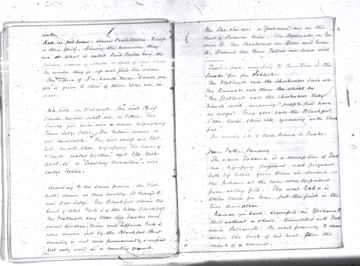
Preserved transcription
Transcription matched to this Wisconsin microfilm frame. Preserved from the supplied frame transcription; compare uncertain readings with the scan.
Lake.
Kah-lis-pél-lums. Lower Pend Oreilles. Victor
is their Chief. During the summer they
are at what is called Pend Oreille bay, the
Indian name of which is that of their band[?].
In winter they go up and join the others.
The name of S'n-hanch-kwoi, "Canoe peo-
ple" is given to those of them who use ca-
noes.
Seh-lish, or Flatheads. The head Chief
Skwāi-kwailt-hehlt-sie, or Victor. The
French give him also a name signifying
Three Lodge Poles. The Indian name is
not translated. The sub chiefs are Hot-
lots-kwoolt-shee, signifying "the hairs of
[illegible] matted together", and Stee-teesh-
hloot-so or "Crawling Mountain", also
called Moise.
According to the same person, the Flat-
head's claim as their territory, St Mary's R.
and Deer Lodge. The Blackfeet claim the
head of that Fork & of the little Blackfoot.
The Flatheads say that the Snakes once
owned Wisdom[?] River and Jefferson Fork &
were driven out by the Blackfeet. That
country is not now permanently occupied
but only used as a hunting ground.
The Sho-sho-coes or "foot men" are on the
head of Salmon River. The Bannaks on Go-
din's R. The Shoshonees on Bear and Green
R. Behind the Three Tetons are some wild
Snakes[?].
Tsoi-e-pan, according to Gunton[?] is the
Snake for the Sehlish.
The Flatheads call the Shoshonees Snō-wa.
The Bannaks call them Au-whiht-sa
The Flatheads call the Shoshocoes Koy-[?]
hanch-kwōk, meaning "people that have
no lodges". They also call the Blackfeet,
S'cke-kwāi-shin-ick, meaning "with black
feet."
The country S.W. of Horse Prairie is Snake.
From Father Pandosy
The name Yakama is a corruption of Yak
-ma, signifying pregnant, iak pregnant
with big bellies, given them in derision as
the Indians at the lake were corpulent
from eating fish. The word Yak-a is
Walla Walla for bear, but the first is the
true derivation.
Kamai-ya-kane, signifies in Spokane
"head without a skull" translated into Yak
ama Pathanote[?]. He used formerly to [struck: shew]
shave the back of his head, then the
mark of a warrior.
Wisconsin Historical Society · WHS-R3-43 · George Gibbs IV (field notebook) (document)
Open the complete archive frame record →