
Read the original · Check the transcription
Gibbs Family Papers, Reel 3, frame 38 (thumbnail)
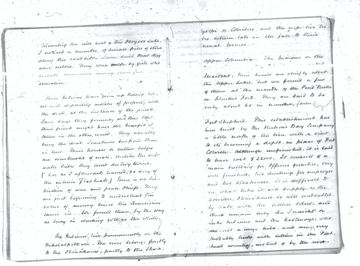
Preserved transcription
Transcription matched to this Wisconsin microfilm frame. Preserved from the supplied frame transcription; compare uncertain readings with the scan.
Mounting the hill east of the Osoyoos Lake,
I noticed a number of small piles of stone
along the road side. Sam said that they
were cultus. They were made by girls who
[illegible] monuments[?] during their first men-
struation.
These Indians have given up killing hor-
ses and depositing articles of property with
the dead, at the instance of the priests.
Sam says they formerly did this that
their friends might have the benefit of
them in the other world. They usually
bury the dead. Sometimes suspend them
in trees. Their houses or rather lodges
are constructed of mats. Unlike the salt
water tribes they dont destroy twins.
[Nor as I afterwards learned, do any of
the interior Flatheads] There is no dis-
tinction of war and peace chiefs. They
are just beginning to understand the
value of money since the Americans
came in. We found them by the way
as busy in washing gold as the whites.
No Indians live permanently on the
Nehoialpitkwu[?]. The river belongs partly
to the Okinákanes, partly to the Shwa-
yelpi or Colvilles, and the respective tri-
bes return late in the fall to their
usual homes.
Upper Columbia. The Indians on the
[illegible, ~5 words] called[?]
Snaitcht[?]. Their homes are chiefly about
the Upper Lakes, but we found a few
of them at the mouth of the Pend' Oreille
or Clarke's Fork. They are said to be
only about 60 in number, (men).
Fort Shepherd. This establishment has
been built by the Hudson's Bay Company
a little north of the line with a view
to its becoming a depot in place of Fort
Colville. Although unfinished, it is said
to have cost $[?] 22000[?]. It consists of a
main building for officers quarters, very
well finished, two dwellings for employes
and two storehouses. It is difficult to
see what tribes it will supply, as the
Colvilles, Okinákanes &c will undoubted-
ly trade with the settlers below, and
there remain only the Snaicht[?] or
Lake Indians and the Kootenays, who
are not a large tribe, and may very
probably trade with settlers in the Flat-
head country, instead of by the river.
Wisconsin Historical Society · WHS-R3-38 · George Gibbs IV (field notebook) (document)
Open the complete archive frame record →