
Read the original · Check the transcription
Gibbs Family Papers, Reel 3, frame 30 (thumbnail)
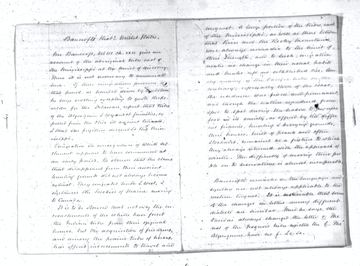
Preserved transcription
Transcription matched to this Wisconsin microfilm frame. Preserved from the supplied frame transcription; compare uncertain readings with the scan.
Bancroft's Hist'y. United States.
Mr Bancroft, Vol III ch. XXII gives an
account of the aboriginal tribes east of
the Mississippi at the period of discovery.
Here it is not necessary to enumerate
these. Of their emigrations previous to
that period, as handed down by tradition
he says nothing excepting to quote Hecke-
welder for the Delaware report that tribes
of the Algonquin & Iroquois[?] families, ex
pelled from the Ohio its ancient tenants,
& that the fugitives descended[?] the Mis-
sissippi.
Emigration in consequence of white set-
tlement appears to have commenced at
an early period. He observes that the clans
that disappeared from their ancient
hunting grounds did not always become
extinct. They migrated North & West, &
instances the Sokokies of Maine moving
to Canada.
It is to be observed that not only the en-
croachments of the whites have forced
the Indian tribes from their original
homes, but the acquisition of fire arms,
and among the prairie tribes of horses,
has offered} inducements to travel and
conquest. A large portion of the tribes east
of the Mississippi, as well as those between
that River and the Rocky Mountains,
were always nomadic to the limit of
their strength, and to such, migration
creates no change in their usual habits
and breaks up no established ties. Am-
ong many of the Pacific tribes on the
contrary, especially those of the coast,
the residence was fixed and permanent,
and though the natives wandered from
spot to spot during the season to procure
food in its variety, as offered by the diffe-
rent fisheries, hunting & berrying grounds,
their houses, built of plank and often
stockaded, remained as a fixture to which
they always returned with the approach of
winter. The difficulty of moving these peo
ple on to reservations is almost insuperable.
Bancroft's remarks on the languages and
syntax are not always applicable to the
western tongues. It is noticeable that some
of the changes in letters among different
dialects are similar. Thus he says, the
Oneidas always changed the letter r. The
rest of the Iroquois tribes rejected the l. The
Algonquins have no f. &c. &c.
Wisconsin Historical Society · WHS-R3-30 · Letter from George Gibbs (reading notes) to notebook
Open the complete archive frame record →